.webp)

AI fluency means your workforce can understand, interact with and apply AI to real work with confidence. Built company-wide, it shows up as measurable behavior change in how work gets done.
That behavior change is where many companies get stuck. People leaders often describe the gap the same way: "We provided enterprise AI licenses to everyone, but the way we work at scale hasn't changed."
Below, we cover what fluency looks like, how it differs from AI literacy and how to measure it across your teams.
Key takeaways
- Fluency means your workforce can understand, interact with and apply AI tools to real problems at work.
- Building organizational AI readiness requires a culture that values hands-on practice, peer learning and measurable behavior change over time.
- You can measure fluency with five behavior signals and a 0 to 4 levels scale, starting with a baseline.
- Electives helps teams build company-wide fluency through live learning, Simulations and analytics that show what is changing.
- AI-fluent employees report being more productive, more creative and better prepared to solve complex business challenges.
- Organizations that prioritize experimentation and practical application over passive learning have a better shot at adoption that lasts.
What is AI fluency?
AI fluency goes beyond knowing what generative artificial intelligence is. It’s the practical skill of working with AI day to day: knowing when to use it, how to direct it and whether to trust what it produces.
Think of it like learning a new language. You can study grammar and vocabulary, but fluency comes when you can hold a conversation without thinking about the rules. The same applies here.
For organizations, company-wide fluency means employees can confidently work alongside AI tools in the flow of work. A claims team can pressure-test a response. A manager can prepare for a difficult conversation. A project lead can move from a blank page to a sharper plan.
That’s what organizational AI readiness looks like in practice: everyone building enough confidence and judgment to use AI well.
AI fluency vs AI literacy
AI literacy focuses on understanding what AI is and how it works. Fluency goes further. It means people can use AI productively in their jobs, with the judgment to know when and how.
Literacy is the foundation. On the levels scale later in this article, it sits at level 1. We help teams move from literacy to fluency through live classes, hands-on practice and measurement.
Why does AI fluency matter now?
Employers feel the pressure. The World Economic Forum's 2025 Future of Jobs Report found that 85% of surveyed employers plan to prioritize upskilling their workforce, while 63% cite skills gaps as a main barrier to business transformation.
That’s the macro picture. Inside your company, the problem feels more specific.
You bought the licenses. Some people are experimenting. Some are avoiding the tools. Some are using AI in ways that make leaders nervous. And the people expected to make adoption happen are stuck between a mandate and a measurement problem.
The challenge: rolling out AI tools isn’t enough.
The opportunity: if you build genuine fluency, you give people the confidence, practice and support to change how work gets done.
Research from Harvard Business Publishing Corporate Learning and Degreed found that highly AI-fluent employees were more likely to report stronger outcomes: 81% said generative AI made them more productive, 54% said it made them feel more creative and 53% said it made them better prepared to solve complex business challenges, according to Harvard Business Publishing.
That’s the difference between access and readiness.
What does organizational AI readiness look like?
Organizational AI readiness is a combination of skills, culture and infrastructure working together.
Here’s what it includes:
- Foundational understanding: Your team knows what AI can and cannot do, and they understand the basics of how it works.
- Practical application: Employees use AI tools in their daily workflows.
- Measurable behavior change: You can track whether people are adopting AI and whether it is improving how work gets done.
- Cultural support: Leaders prioritize AI learning, and employees have time and permission to experiment.
When these elements come together, you have the foundation for lasting AI adoption.
When they don’t, you get uneven usage. A few early adopters move fast. Everyone else waits for clearer rules, better examples or a reason to believe the tools are safe to use.
That is why we say the best AI strategy is a People strategy. The software can be ready before your people are. Your AI adoption strategy has to close that gap.
Why doesn't passive learning build AI fluency?
Most enterprise training for AI starts with content: videos, explainers, resource libraries and one-time workshops. These can be helpful starting points. They rarely lead to real fluency on their own.
The Harvard Business Publishing study found that AI-fluent employees were two times more likely to say they learned about generative AI through experimentation compared with other respondents, according to Harvard Business Publishing.
That makes sense, because you wouldn’t expect someone to become fluent in Spanish by only reading a textbook. You’d expect them to practice speaking, make mistakes and learn from real conversations.
Fluency works the same way. Employees need opportunities to test, apply and refine their skills in realistic work contexts. They need a safe space to practice before doing it live.
This is where a lot of AI programs stall. They teach the tool, then assume the behavior will follow. It usually does not.
How do live learning and AI simulations build fluency?
The approach matters. Pre-recorded content has its place, but it cannot replicate the experience of live, interactive learning.
Live Electives™ classes let learners ask questions, work through scenarios together and get real-time feedback from vetted experts. That human layer matters because AI adoption is full of judgment calls: what to share, what to trust, when to verify and how to use AI without lowering the quality of the work.
AI simulations take it a step further. They give employees a safe space to practice applying AI in realistic scenarios, with instant feedback and room to try again.
That practice is what turns knowledge into fluency.
It is also what makes learning feel relevant. A generic AI overview might explain a prompt. A simulation lets a manager practice using AI to prepare for a conversation they need to have.
For teams building company-wide AI fluency, the goal is a system that helps people practice until the new behavior shows up at work.
How do you measure AI fluency in the workplace?
You measure AI fluency in the workplace by tracking five behavior signals, placing people on a shared levels scale and using the same measurement across every team. You can’t improve what you cannot see, and tracking fluency helps you identify gaps, celebrate progress and decide where to focus next.
The five signals worth tracking
- Adoption patterns: Who is using AI tools, and where is usage uneven? Capture it with a usage export from your AI platforms, broken down by team and role.
- Skill confidence: Can employees use AI for practical work? Capture it with a survey item such as "I can use AI to complete a core task in my role," rated 1 to 5.
- Application: Are people bringing AI into real workflows? Capture it with a manager check in regular 1:1s, noting one workflow where each person now uses AI.
- Behavior change: Are learners doing something differently after training? Capture it by running the same survey before training and 30 days after.
- Business relevance: Is AI helping teams save time, improve quality or move faster? Capture it by timing a defined task, such as a first draft of a client proposal, before and after training.
Levels of AI fluency
A levels scale turns these signals into one shared picture. Place individuals on the scale, then roll results up to teams.
Level 3 is a realistic target for most roles. Level 4 is where your internal champions come from.
How to measure AI fluency across teams
- Baseline first. Measure before training starts so you have something to compare against. We wrote more about why AI-first organizations need a fluency baseline.
- Use the same instrument for every team. Same survey items, same levels and same manager check, so differences reflect people and teams.
- Segment by function and manager. Fluency tends to cluster, and a manager who uses AI openly can lift a whole team.
- Compare team to team. An absolute target like "everyone at level 3" hides where progress is happening. Comparing teams shows you where to invest and whose approach to copy.
- Re-run quarterly. AI tools change fast, and a quarterly check shows movement without survey fatigue.
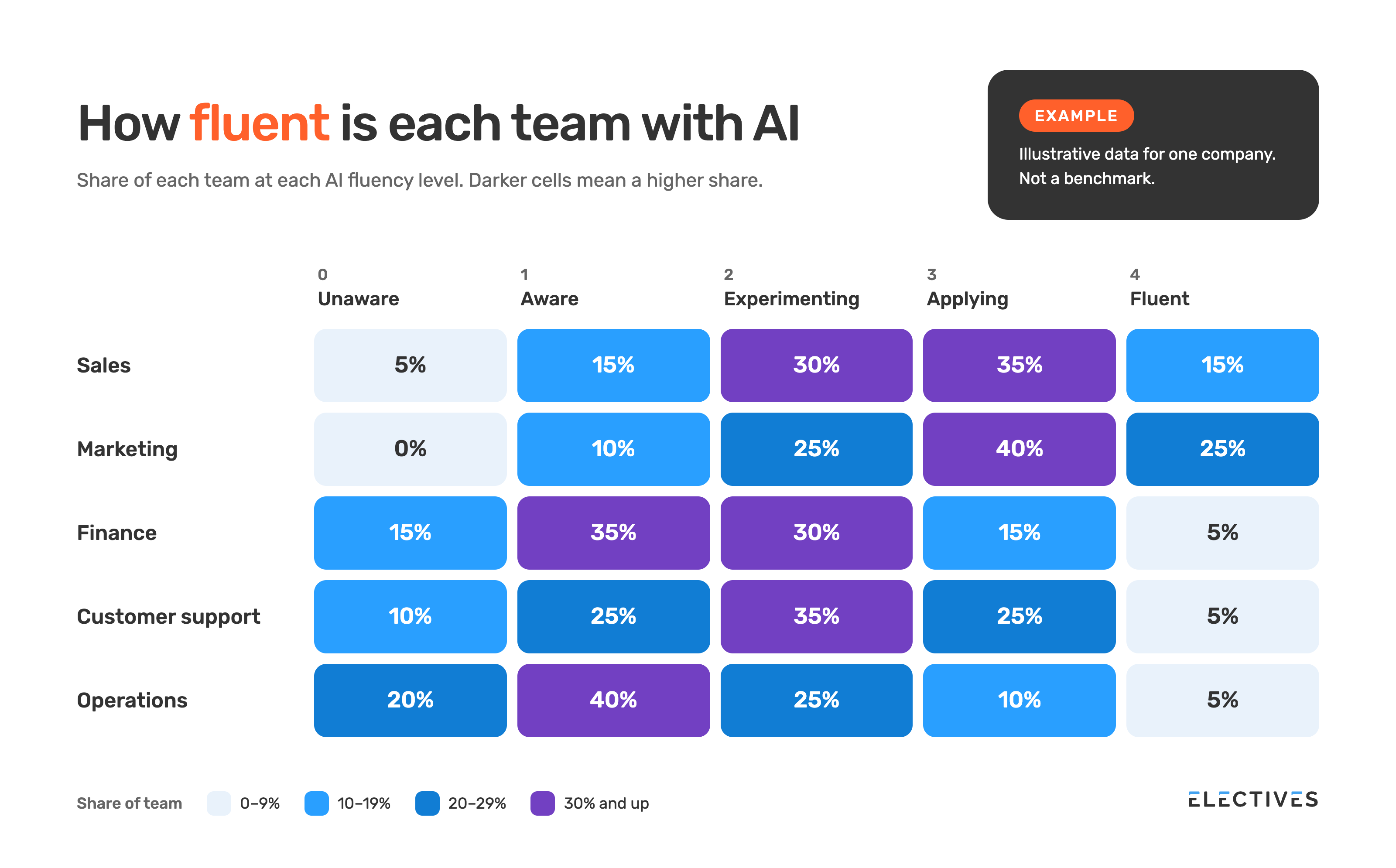
At Electives, we start with our AI fluency assessment, so you can stop guessing and start with a baseline. In under a week, you can see fluency, sentiment, confidence, blockers and opportunities across your organization. From there, you decide what each team needs next.
What not to measure
Some of the easiest numbers to pull tell you the least about fluency.
- Completion rates: They tell you someone finished something. They don’t tell you whether the work changed.
- License counts: They tell you who has access.
- Prompt volume: It tells you who’s busy. Heavy use and good use are different things.
Track them if procurement needs them. Keep them out of your fluency score.
What sets effective AI fluency programs apart?
Not all programs are created equal. The ones that build real AI readiness share a few traits.
First, they focus on practical application. Employees learn by doing.
Second, they make learning ongoing. A one-time class is not enough. AI tools evolve quickly, and fluency requires continuous practice and skill maintenance.
Third, they measure outcomes. The goal is measurable behavior change and ROI leadership can see.
This is the gap that we built Electives to close. We combine live, expert-led learning with simulations for practice and analytics that show progress. Our AI training for employees is designed to move organizations from uneven usage to roughly 2x AI adoption, with 92% of learners reporting behavior change and 98% applying new AI skills within one week.
How do you build a culture that supports AI fluency?
Even the best LLM training will struggle if your culture doesn’t support it. Building fluency requires a shift in how people learn, practice and talk about work.
Here’s what that looks like in practice:
- Leadership modeling: When leaders use AI thoughtfully and talk about what they are learning, employees get permission to do the same.
- Time for experimentation: People need room to try new workflows and make small mistakes before the stakes are high.
- Peer learning: Employees learn faster when they can see how someone like them is using AI.
- Psychological safety: People need to ask basic questions without feeling behind.
This is why building AI culture belongs with the people-and-behavior side of the organization. IT can provide access. Legal can define guardrails. But culture changes when people have practice, support and a shared understanding of what good looks like.
Your job is to make AI usable, safe and relevant enough that people change how they work.
Building AI fluency that lasts
Company-wide fluency is an ongoing process of learning, practicing and adapting.
The organizations that succeed will treat AI readiness as a strategic priority. They will invest in live learning that keeps employees engaged, hands-on practice that builds real skills and analytics that prove what is working.
For People teams, this is a chance to shape one of the biggest shifts in how work gets done. Start by assessing where your organization stands today. Then build from there.
If your AI licenses are live but your workflows haven’t changed, we can help you see where people are confident, where they are stuck and what to do next. Start with our AI Fluency & Culture Assessment, then build a path from uneven usage to real AI readiness.
.jpeg)


.jpeg)