Assessing AI readiness means measuring whether your people have the skills, confidence and support to change how they work with AI, on a team by team basis. It essentially gives you a baseline before you invest in more training or tools.
Licenses and prompt counts show activity. In 2026, the credible benchmark for workforce AI readiness is whether people change workflows, apply AI to real use cases and create measurable impact. Enterprise AI pilots can be everywhere and still produce little measurable return, as MIT's 2025 State of AI in Business report found.
Below, we cover what an assessment should measure, a framework and checklist you can use, how to choose a provider and what to do with your results.
Key takeaways
- A readiness assessment gives you a team-by-team baseline of skills, confidence and blockers, which usage data like license counts and prompt volume can’t show.
- A strong AI readiness assessment framework covers five dimensions: skills, confidence and blockers, use cases and workflows, manager reinforcement, and business impact.
- A ten-question checklist helps you test readiness, from your starting point to whether you can prove business impact.
- The right provider gives you anonymous responses, results by team and manager, a fast baseline and a plan you can act on.
- Electives helps teams close readiness gaps with live classes, AI simulations and analytics, with 92% of learners reporting behavior change and 98% applying new AI skills within one week.
What is an AI readiness assessment?
An AI readiness survey is a short, usually anonymous survey that People, HR and L&D leaders use to see how ready each team is to work with AI. The result is a baseline that shows where adoption is strong, where it’s stuck and where to invest first.
To get there, it should measure the human conditions required for AI to change work.
That starts before training. You need to know who is confident, who is blocked, who is experimenting safely, which teams have real use cases and where adoption is uneven. Otherwise, you're guessing.
Most companies won't fail at AI because they picked the wrong tools. They'll fail because their workforce never changed how work gets done.
That's why workforce AI readiness works as a behavior-change benchmark. A useful benchmark tells you:
- Which employees understand where AI fits their work.
- Which teams have practical use cases worth scaling.
- Where fear, risk, policy confusion or lack of confidence is slowing adoption.
- Whether employees can apply AI skills on the job after a class.
- Whether workflows are improving in ways the business can see.
Using AI well requires more than a login and an okay prompt. It requires AI fluency in the kinds of behaviors that drive smart usage:
- Asking clear, structured questions.
- Interpreting results critically.
- Spotting bias or risk.
- Translating AI outputs into real decisions.
These are human skills: critical thinking, digital literacy, communication and ethical reasoning. And they don't show up overnight.
Why doesn't AI usage show readiness?
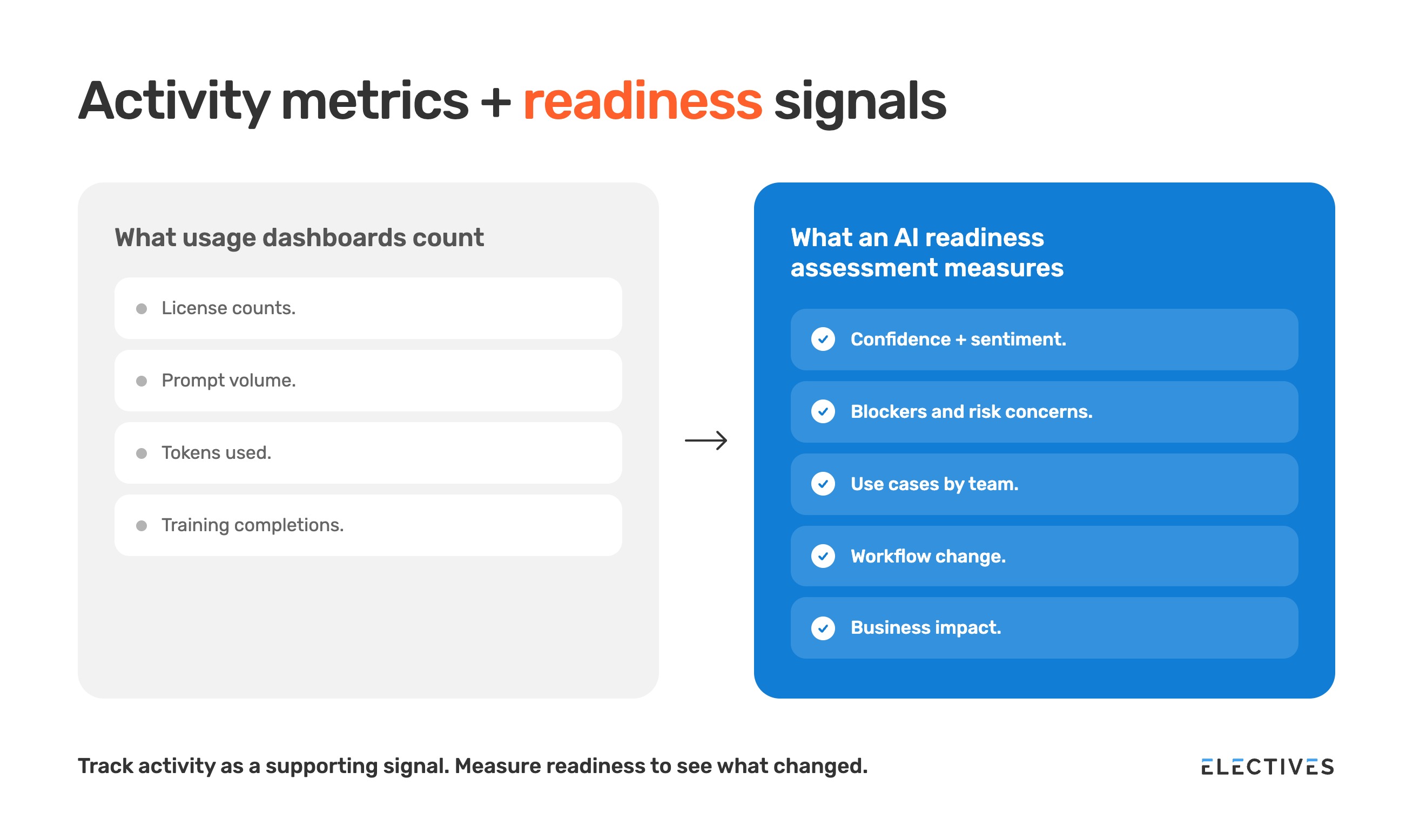
AI usage data shows that people are using AI tools. It can’t show whether their work, decisions or results changed.
Token maxxing is what happens when AI usage becomes the goal.
More tokens. More prompts. More automated runs. More people on the leaderboard.
That can look like momentum but it can also hide the truth.
A team can burn through tokens and still make the same decisions, run the same meetings, write the same handoffs and review the same work twice because no one trusts the output.
Built In defines tokenmaxxing as maximizing AI usage by consuming as many tokens as possible, often treating high utilization as a proxy for productivity regardless of the output.
A company-wide usage chart can make adoption look broad when it's narrow.
One team may be using AI for customer research synthesis. Another may be asking it to rewrite emails. Another may be avoiding it because policy feels unclear. The aggregate number shows usage going up. The team-by-team view shows readiness is uneven.
Anthropic's Economic Index shows why this matters. In one analysis of Claude.ai usage, Anthropic found that even across 3,000 unique work tasks, the top 10 accounted for 24% of activity, and that AI's impact remains uneven across countries, occupations and task coverage.
AI readiness assessment framework
An AI readiness assessment framework scores your organization on five dimensions: skills, confidence and blockers, use cases and workflows, manager reinforcement, and business impact. Score each dimension team by team, since readiness is rarely even across an organization. Then re-run the assessment every three to six months to see what’s moving.
McKinsey’s 2025 state of AI research shows why the use cases and business impact rows matter. The report found that only 21% of respondents whose organizations use gen AI say their organizations have fundamentally redesigned at least some workflows. It also found that, among 12 adoption and scaling practices, tracking well-defined KPIs had the strongest relationship with bottom-line impact, while less than one in five respondents said their organizations were tracking KPIs for gen AI solutions at all.
What readiness looks like by role
Readiness looks different for individual contributors, managers, and leadership teams, so your assessment should also break results down by role and by team.
Individual contributors. Need to know how to use AI for research, planning, task automation and communication, without sacrificing context or accuracy. Focus areas:
- Structured prompting.
- Time management with AI assistance.
- Cross-checking AI-generated content.
Managers. Need to help teams think critically, use AI responsibly and integrate tools without creating confusion. Focus areas:
- Ethical use and accountability.
- Coaching team members on best practices, what should be AI and what should be human-based.
- Aligning AI use with strategic goals.
Executives and People teams. Need to ensure policies are clear, skills are built and adoption doesn't outpace capability. Focus areas:
- AI literacy as part of onboarding and development.
- Tracking behavioral ROI alongside tool usage.
- Modeling responsible use.
AI readiness assessment checklist
Use this AI readiness assessment checklist to see whether your organization is ready to change how it works with AI. Input metrics like license activation, attendance and utilization still matter as supporting signals, and the ten questions below cover what they miss.
- Do we know our starting point? Baseline tool fluency, confidence, sentiment, blockers and team-by-team readiness before you launch more training.
- Can people prompt an AI tool effectively? Clear, structured requests get usable output. Check whether people can write them for their own tasks.
- Can they tell useful output from noise? Look for people who check facts, spot gaps and know when an answer isn't good enough to use.
- Are employees applying AI to real use cases? Track use cases tied to actual workflows, such as drafting client proposals or summarizing case files.
- Are workflows changing? Look for redesigned steps, reduced manual rework, clearer handoffs and better use of employee time.
- Is decision quality improving? AI that helps someone make a bad decision faster only creates risk faster.
- Are employees confident and safe? Measure whether people know when to use AI, when not to use it, where human judgment still matters and how to manage risk.
- Where are adoption gaps? Compare teams, roles and functions so support goes where it's needed.
- Are managers reinforcing the behavior? Managers turn AI from a personal experiment into a team operating habit, so check that they're equipped to guide AI-assisted decisions.
- Can we prove business impact? Tie AI adoption to cycle time, quality, customer outcomes, cost reduction or capacity created.
Deloitte's 2026 State of AI in the Enterprise research points in the same direction: roles, skills and career paths need rebuilding as organizations redesign work around AI. The report is based on a survey of 3,235 leaders across 24 countries in 2025.
If the answer to any of these is "sometimes" or "we're not sure," that's your cue. It means training needs to shift from tool-based to behavior-based.
How to choose an AI readiness assessment provider
To choose an AI readiness assessment provider, look for one that measures behavior and confidence beyond tool usage, shows results team by team, and gives you a plan you can act on. A weak assessment hands you the same activity data you already have, with a new label. Use these criteria and questions to compare providers before you commit:
At Electives, we start with our AI fluency assessment. Each employee spends about ten minutes on around 30 anonymous questions, and you see results within one week, with a strategic plan two weeks after launch. The assessment measures fluency on an 11-level scale, along with manager support, trust and safe use, culture and barriers, and ambition. You get a filterable dashboard and a strategic insights report, and you can re-run it at three or six months to track progress.
What to do with your results
Use your assessment results to target learning at the teams and skills with the biggest gaps, then report progress to leadership as those gaps close.
Turn gaps into targeted learning
Match the learning to what the assessment found: hands-on practice for teams with skill gaps, clearer guidance where confidence is low, and manager support where new habits aren’t sticking.
AI training doesn't need to be a separate program. The most effective teams embed AI literacy into existing development.
Try:
- Quick-hit simulations where employees practice tough workplace conversations and get instant feedback.
- Live sessions focused on real use cases by function or role.
- Learning tied to feedback and review cycles ("How have you used AI to improve this quarter?").
Electives’ AI simulations work especially well here. They give employees a safe space to practice tough workplace conversations, with instant feedback on tone and delivery, before they have them for real.
At Electives, that means live, expert-led classes, realistic simulations and analytics that prove behavior change. In our programs, 92% of learners report behavior change and 98% apply new AI skills within one week of training. For a practical evaluation lens, our AI training for employees 2026 framework walks through how to compare programs on rollout, practice, governance and measurable behavior change.
Report progress to the board
To report AI progress to the board, show where your workforce started, where the gaps are, what you did about them and what changed as a result.
A board doesn't need to hear that people have access to AI. They need to know whether the organization is getting better because of it.
That means that the board reporting AI progress should move from "who has a license?" to "what changed in the business?"
A stronger board narrative looks like this:
- Starting point: "We assessed fluency, confidence, sentiment and blockers across teams."
- Adoption gaps: "We found three teams with high confidence but low use-case clarity, and two teams with strong use cases but risk concerns."
- Action taken: "We targeted live learning and practice by team need."
- Behavior change: "Learners are applying AI skills within the week and managers are reinforcing new workflows."
- Business signal: "We're tracking cycle time, quality, capacity created and customer-facing improvements tied to priority use cases."
It gives the board something license counts can't: a view of whether the workforce is becoming AI-first in practice.
Start with a baseline
The first step toward AI readiness is a baseline: a clear view of where your people stand today, team by team. The best AI strategy is a People strategy.
If your AI report is still built around tokens, prompts, licenses and completions, you're measuring the easiest part of the change.
Start with an AI readiness assessment. See the blockers. Find the teams already moving. Then build the learning, practice and measurement system that turns AI from individual experimentation into a new way of working.
When your team knows how to think, act and decide with AI in the loop, you see the impact: better decisions, faster workflows, fewer mistakes and more time for strategic work.