.webp)
.jpeg)
AI adoption often starts in the same place. A small group of employees dives right into Claude. They experiment and start building. They can’t stop talking about it and over time, they become the AI super users on the team.
Another team starts using AI to speed up research, write emails, analyze data, or build presentations. A few employees start sharing prompts in Slack.
Most people are excited. Some people are skeptical.
But then, nothing really changes. The value from AI is not captured.
This is one of the biggest challenges with enterprise AI adoption today: AI use can spread without AI becoming part of how the organization actually works and the work itself does not get redesigned.
You can have hundreds or thousands of employees using AI every day and still have an organization that isn't truly AI-first.
Why?
Because you can't build an AI-first organization by building a collection of AI-first individuals.
You have to change how teams work. And eventually, you have to change how the organization works.
AI adoption gets stuck in the individual
Most companies have some version of this story. You give employees access to ChatGPT, Claude, Gemini, Copilot, or another AI tool.
Some people jump right in.
They experiment. They build custom workflows. They create agents. They find shortcuts that save hours. Maybe there is even a lunch and learn where the super user shows off their fancy demo.
But others barely touch the tools. Some are curious but don't know where to start. Some are worried about making mistakes. And some are waiting for their manager to tell them what AI means for their job. The result is an uneven organization.
A few AI power users are moving incredibly quickly while everyone else continues working roughly the same way they did before.
This creates an AI adoption gap inside the company. And the gap isn't necessarily about access to technology. It's about confidence, skills, incentives, workflows, leadership, and the opportunity to practice.
Recent research from McKinsey makes a similar point: individual AI productivity gains don't necessarily translate into enterprise value when the organization around those individuals stays the same.
That's the problem with thinking about AI adoption as a software deployment. More than adopting AI, your people adopt new ways of working.
Enterprise AI adoption is a team sport
Imagine you have a sales rep who has become an incredible AI user. They can research prospects in minutes.They can personalize outreach. They use AI at work to prepare for meetings and summarize calls. They've probably become significantly more productive.
But what happens when they hand that work to the rest of the sales team?
If everyone else is still following the same sales process, using the same templates, and spending the same amount of time on research, you haven't really changed the sales organization.
You've created one exceptionally efficient salesperson, which isuseful. But, it's not an AI-first sales organization.
The same thing happens everywhere. An HRBP becomes great at using Claude. One marketer builds an incredible content workflow. A finance analyst creates an AI-powered reporting process. A product manager starts using AI to synthesize customer research.
These are great examples of experimentation.They are also clues.
The real opportunity is to take those individual discoveries and turn them into team-level ways of working.
That's where enterprise AI adoption starts to become meaningful.
So, how do you drive AI adoption across enterprise teams?
The answer isn't another 60-minute "Introduction to AI" webinar.
It's also not sending everyone a list of 100 prompts. And it's definitely not measuring success by how many employees logged into an AI tool.
If you're thinking about how to drive AI adoption across enterprise teams, start with five things.
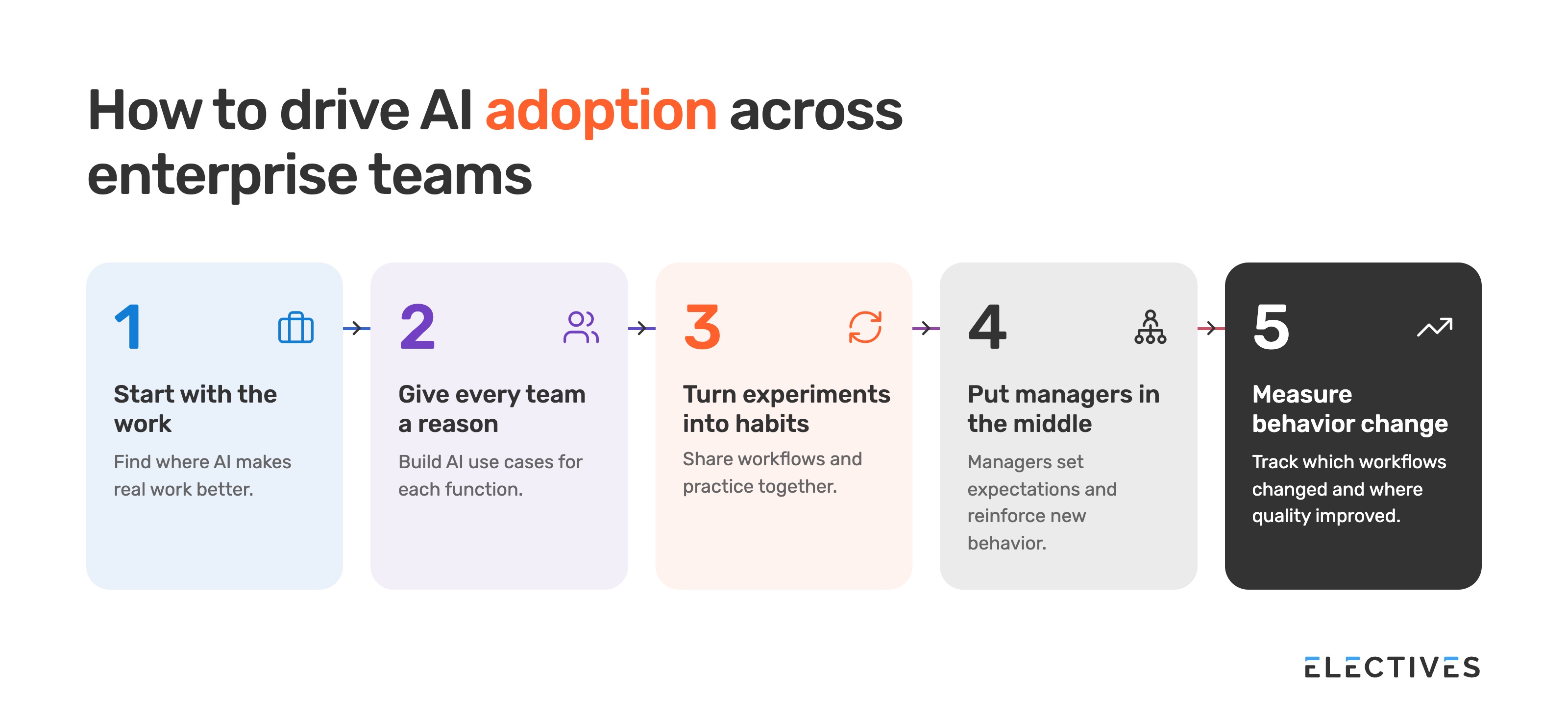
1. Start with the work, not the tool
One of the easiest ways to slow down AI adoption is to start with the technology.
"Everyone has access to Claude. What should we teach them?"
Instead, start with the work. What takes too long? Where are people repeatedly starting from a blank page? Where are teams spending hours summarizing, researching, organizing, analyzing, or creating? Where are people doing work that AI could help with—but where human judgment still matters?
The question isn't:
"How do we get people to use AI?"
It's:
"Where could AI make the way we work meaningfully better?"
This changes the conversation, soAI becomes connected to real problems instead of becoming another corporate initiative. It also makes adoption much easier to understand.
People are far more likely to change a behavior when they can immediately see why that behavior matters.
Collect the answers to these questions and other problems to solve in an AI fluency assessment across the team.
2. Give every team a reason to use AI
There is no universal AI workflow.
The best AI workflow for Finance probably isn't the best workflow for Sales. The best workflow for Recruiting probably isn't the best workflow for Product. And the best use of Claude for an engineer might be completely irrelevant to an HRBP.
That's why enterprise AI adoption needs to move beyond generic AI literacy.
Every team should be asking:
What does AI change about the work we do?
For Marketing, that might mean moving from content creation toward faster research, experimentation, and iteration.
For Sales, it might mean better account research and more personalized preparation.
For Finance, it might mean spending less time manipulating information and more time interpreting it.
For People teams, it might mean faster analysis, better employee communications, and more time spent on the human parts of the job.
The technology may be the same but the behaviors will change. Run AI training by teams and by uses. One size fits all training fits none.
3. Turn individual experimentation into team habits
This is where many generative AI enterprise adoption efforts fall short.
Someone discovers something amazing. Everyone says, "That's cool."
Then everyone goes back to work.
Instead, create a mechanism for experimentation to become shared learning.
For example:
- Have teams identify repetitive workflows that could be improved with AI.
- Give employees dedicated time to experiment
- Share successful workflows across the team.
- Let employees teach one another.
- Build lightweight AI playbooks around real work.
- Practice new workflows together.
- Give managers a role in reinforcing the new behavior.
An AI hackathon can be particularly powerful here. Not because everyone needs to become an engineer. Because people need time to work together on real problems. One of the top reasons barriers people reference in the AI fluency assessment is “time” to experiment.
When teams experiment together, they don't just learn a tool. They learn from one another. They discover what AI is good at. They discover where AI isn't good enough.
And they start building a shared understanding of what "AI-first" actually means for their work.
4. Put managers in the middle of the change
Managers are one of the most overlooked parts of AI adoption in the enterprise.
Employees don't just look to their company's AI policy. They look to their manager.
What does my manager expect me to use AI for? Is experimentation encouraged? Is it okay if I spend time learning? What work should I be delegating to AI? What work should stay human? How should I check AI's output? What does good performance look like now?
These questions matter because AI changes more than individual productivity; it changes expectations.
A manager who continues measuring work exactly the way they did before may unintentionally discourage AI adoption. The manager's role is increasingly to help the team figure out:
What should humans do? What should AI do? And how should we work together?
That's a very different management challenge than simply teaching someone how to write a better prompt.
5. Measure behavior change, not AI activity
This may be the most important shift.
It's easy to measure:
- AI licenses purchased
- Employees activated
- Prompts submitted
- Tokens consumed
- Training attendance
Those numbers can be useful. But they don't tell you whether work changed.
A better set of questions is:
- Which workflows are now AI-assisted?
- Which teams have redesigned how they work?
- How frequently are employees using AI in meaningful workflows?
- What work is happening faster?
- Where has quality improved?
- What new work can employees do that wasn't practical before?
- Are managers reinforcing AI-first behaviors?
- Are employees confident deciding when to use AI—and when not to?
- Are we capturing value?
The goal isn't maximum AI usage. The goal is better work.
That distinction matters.
OpenAI's latest enterprise research, for example, points toward a shift from AI as an assistant toward AI carrying out more substantive work, including through agents and connections to organizational context and workflows.
The deeper adoption gets, the less useful it becomes to think about AI as simply another application employees open.
It becomes part of the operating system for how work gets done.
The next stage of enterprise AI adoption: redesign the workflow
There is a natural progression here.
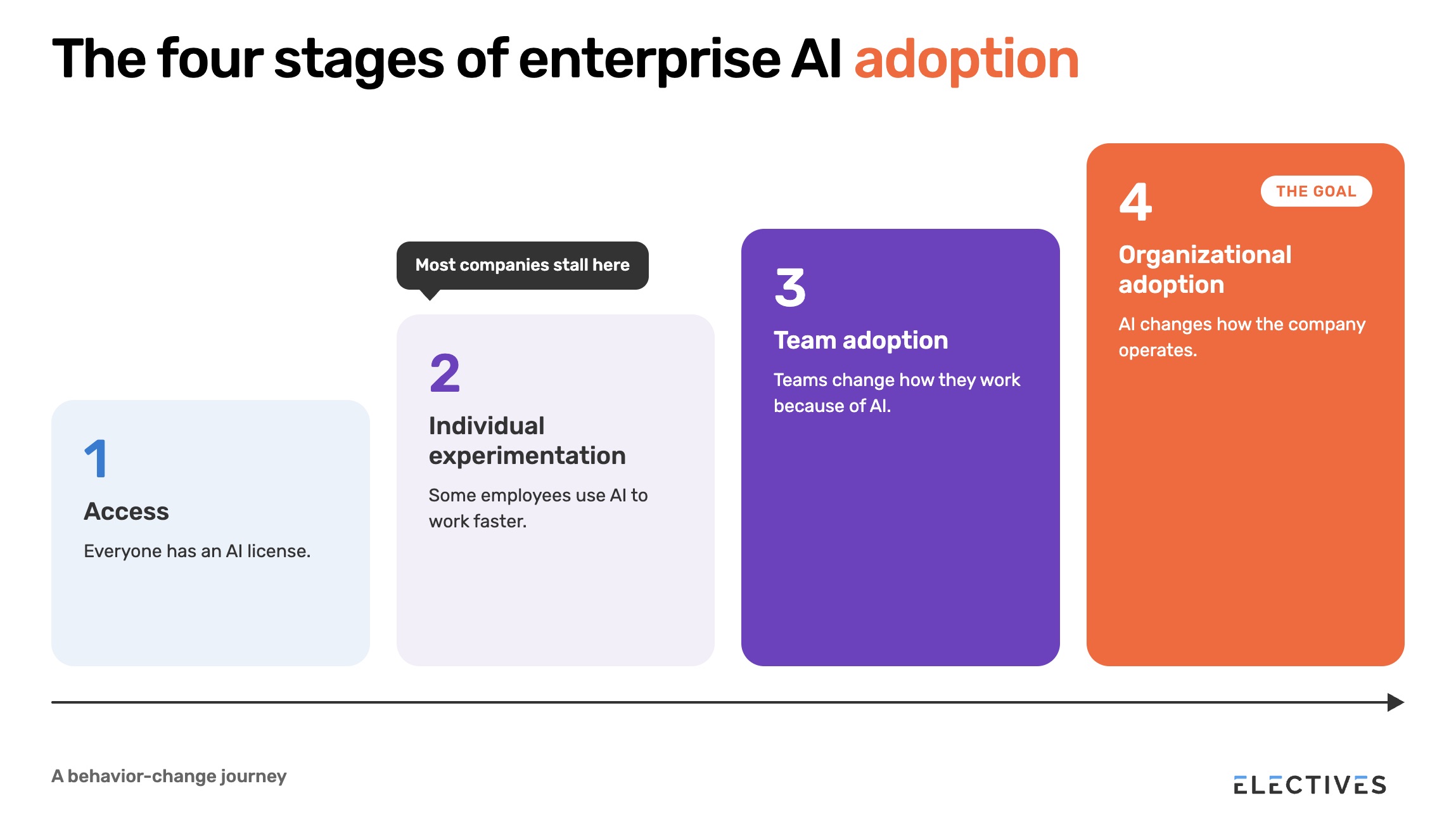
Stage 1: Access
"Everyone has an AI license." Good start.
But access isn't adoption.
Stage 2: Individual experimentation
"Some employees are using AI to work faster."
Now you're seeing potential. But you're still dependent on individual behavior.
Stage 3: Team adoption
"Teams are changing how they work because of AI."
This is where things get interesting. AI starts becoming part of repeatable workflows.
Stage 4: Organizational adoption
"AI changes how the company operates."
This is the goal. AI is built into processes, expectations, decision-making, management, collaboration, and learning.
The journey from Stage 1 to Stage 4 is not primarily a technology journey. It's a behavior-change journey.
Build AI capability, not just AI access
The companies that make meaningful progress with enterprise adoption of generative AI won't necessarily be the ones with the most AI tools.
They'll be the ones that help their people build the capability to use those tools well.
That means developing more than technical proficiency.
People need to know how to:
- Identify problems AI can help solve
- Break complex work into useful steps
- Give AI the right context
- Evaluate AI output
- Recognize hallucinations and weak reasoning
- Decide when human judgment matters most
- Build repeatable workflows
- Collaborate with AI
- Experiment safely
- Teach others what they've learned
In other words, AI fluency is about knowing how to think about work differently.
That is why People, HR, and L&D leaders have such an important role to play in AI adoption.
IT can provide the tools. Security can establish the guardrails. Executives can set the direction.
But people leaders can help the organization actually change.
AI-first doesn't mean AI everywhere
There's another important nuance.
Building an AI-first organization doesn't mean forcing AI into every task.
In fact, that's probably the wrong goal. Some work should remain deeply human.
Some decisions require judgment. Some conversations shouldn't be automated. Some customer interactions are better because a person is paying attention.
The point isn't to replace human work with AI. It's to make thoughtful decisions about where AI can help people do better work.
That's why the most useful question isn't:
"Where can we use AI?"
It's:
"Where can AI and humans working together create a better outcome?"
That distinction keeps the human in the lead.
The real enterprise AI adoption strategy
If you're leading AI transformation, HR, People, or L&D, it can be tempting to look for the next AItraining program, tool, platform, or announcement.
But the bigger opportunity is simpler.
Look across the organization and ask:
Are our people working differently yet?
If the answer is "not really," you probably don't have an AI adoption problem.
You have a behavior-change problem. And that means the next phase of AI adoption in the enterprise needs to move beyond AI super users.
It needs to move from individuals to teams. From experimentation to workflows. From broad based training to team specific, hands-on-keys training.
From access to capability. From "look what AI can do" to "look how we work now."
Because an AI-first organization isn't a company where everyone knows how to use AI.
It's a company where people have learned how to work differently because AI exists. That's the real work of enterprise AI adoption.

.jpeg)