


Your AI strategy needs an AI fluency assessment.

Why AI-first stalls after the initial adoption phase


AI use cases are in silos
No shared standard, no common language. A hundred private versions of how to use AI, and no picture of any of them.
The same work gets done twice
People rebuild each other's workflows without knowing. Output gets checked twice because nobody is sure what it is worth.

Managers have nothing to go on
Asked how their team is doing with AI, they give an honest guess. A guess is all that exists.
Five dimensions, measured across every team.
Around 30 questions, and ten minutes per employee. All responses are anonymous.
Fluency
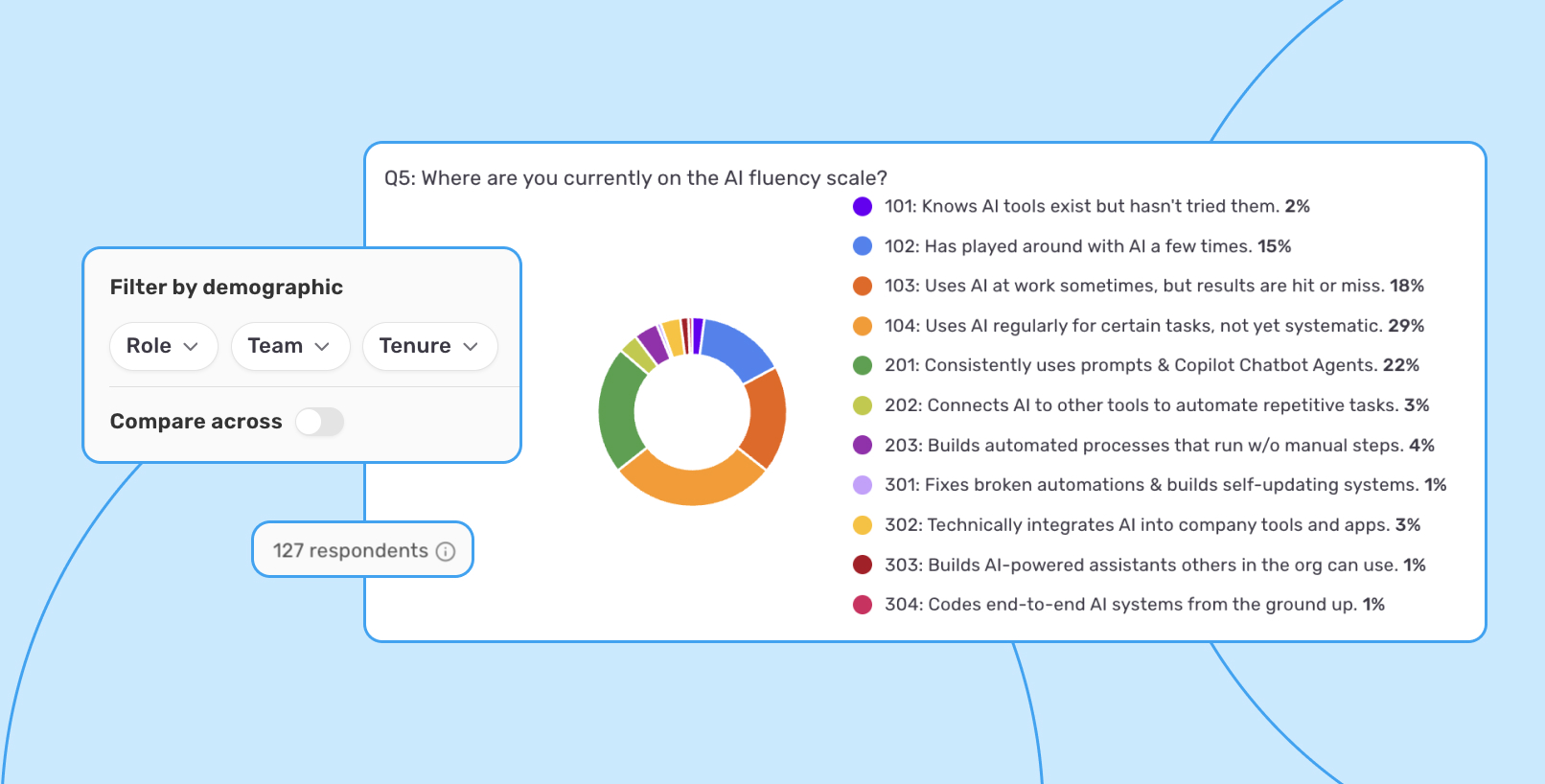
Every employee places themselves on an 11-level scale, from knowing AI tools exist to building systems others in the company use. You get the distribution, the median and the gap between where people are today and where they expect to be in six months.
Manager support
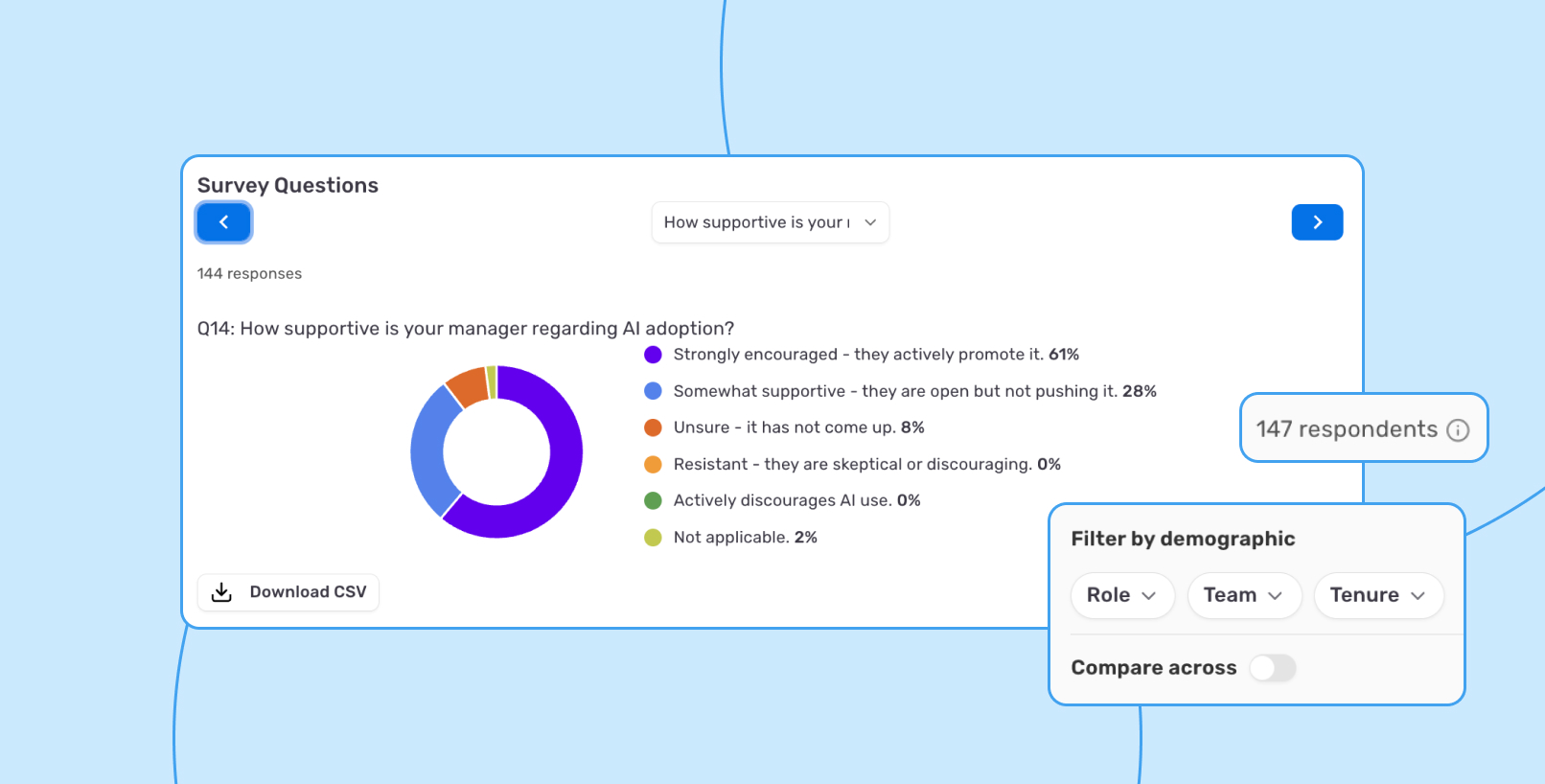
Employees report whether their manager encourages AI use, ignores it, or discourages it. Manager behavior predicts adoption more reliably than tenure, team or role, and the answers show you which managers are carrying the rollout and which are quietly stalling it.
Trust and compliance
How often people verify AI output before they use it, and whether they know what should never go into an AI tool. Heavy verification is a hidden time cost. Uncertainty about what is permitted is an organizational risk.
Culture and barriers
What is genuinely blocking adoption, in employees' own words, alongside the specific tasks that took longer than they should have. These answers name the friction that adoption metrics never surface.
Ambition
How much employees believe AI could improve their work, and the ideas they have for using it. A low ceiling here signals a creativity gap rather than a skills gap, and it calls for different training than a tools class.
What you get back
The interactive dashboard
The strategic insights report
The AI fluency levels

Exploring · 101 to 104
AI is in the building, but it lives with individuals. People use it for tasks they already know it handles, and results vary depending on who is asking. Nothing is repeatable yet.
101 — Knows AI tools exist but has not tried them.
102 — Has experimented with AI a few times.
103 — Uses AI at work sometimes, with hit-or-miss results.
104 — Uses AI regularly for certain tasks, but not systematically.
Automating · 201 to 203
People have moved from asking AI for things to building with it. Prompts become templates, templates become connected workflows, and work starts running without someone driving each step.
201 — Consistently uses prompts, templates and custom assistants.
202 — Connects AI to other tools to automate repetitive tasks.
203 — Builds automated processes that run without manual steps.
Building · 301 to 304
A smaller group is now producing things other people use. The question shifts from personal productivity to what the organization can build and maintain.
301 — Fixes broken automations and builds self-updating systems.
302 — Integrates AI into company tools and applications.
303 — Builds AI-powered assistants others in the organization can use.
304 — Codes end-to-end AI systems from the ground up.
How it works
- 01
Launch the assessment
We customize the questions to your organization and the AI tools your teams already use, then send you one link to share. Employees answer in around ten minutes.
 02
02Get your results in one week
Your dashboard goes live and our team writes up a strategic insights report: where each team sits, what is blocking adoption, and which gaps matter most.
 03
03Turn it into a plan
We recommend specific classes tied to the gaps your data found, sequenced so each one builds on the last.
Who it's for

Head of Learning and Development

Head of People or HR
Head of AI Transformation
Head of Talent Development

Frequently asked questions
An AI fluency assessment, sometimes called an AI skills assessment, measures how well the people in an organization can use AI in their work. Employees answer questions about their current skill level, the tools they use, how much they trust AI output, what their manager expects of them, and what is getting in their way. The result is a picture of where a workforce stands, broken down by team and by level of seniority.
About ten minutes per employee. Most companies run it over a week or two so people can answer when it suits them, then receive results shortly after it closes.
No. Companies can purchase a standalone AI fluency assessment, but the most common approach is purchasing the AI fluency assessment + a core Electives bundle of classes. Many companies begin here, see where the real gaps are, and build their program from what the data shows.
AI literacy is understanding what AI is and how it works. AI fluency is using it well in your actual job. Someone can explain how a large language model works and still not have changed how they do their work, and the reverse is common too. This assessment measures fluency, because that is what shows up in output.
A team AI fluency assessment works by having every employee place themselves on the same 11-level scale, from knowing AI tools exist to building systems other people use. Your organization's score is the median across everyone who responded, reported by department and by leadership level as well as company-wide.
Your team gets a live dashboard and a written report. The report names the gaps and recommends specific classes tied to them, sequenced so each builds on the last.
Not in the sense of a quiz with right and wrong answers. Employees place themselves on a defined scale, and the value is in the pattern across a whole organization rather than in any individual score.
Learn more
Find out where
Your People Stand.
You can’t build an AI-first organization on assumptions. Two weeks from now, you won’t have to.

