.webp)
.jpeg)
AI is changing the skills people need at work.
But probably not in the way many companies expected.
The conversation around AI skills used to focus heavily on technical expertise: machine learning, data science, Python, model development and prompt engineering.
Those skills still matter. But in 2026, the bigger opportunity is much broader.
Employees across nearly every function need to know how to work with AI, evaluate what it produces, redesign parts of their workflow and make good decisions about when not to use it.
At the same time, skills like analytical thinking, creativity, collaboration, leadership and adaptability are becoming even more important.
To understand what AI skills are in demand, look at the full combination of skills and how they work together.
For People, HR and L&D leaders, that creates an important question:
How do we build these skills across the workforce without trying to turn everyone into an AI engineer?
What are the most in-demand AI skills?
The most in-demand AI skills in 2026 generally fall into six categories:
- AI literacy and fluency
- Prompting and AI interaction
- AI-assisted problem solving and workflow design
- AI evaluation and critical thinking
- AI agents and automation
- Human skills that become more valuable alongside AI
Technical AI and machine learning skills remain important for specialized roles. But for most employees, the goal isn't to become a machine learning engineer.
The goal is to become capable of working effectively in an AI-enabled environment.
That distinction matters.
A finance employee doesn't necessarily need to understand how a large language model is trained. They do need to know how to use AI to analyze information, challenge an output, protect sensitive data and incorporate AI into their financial workflows.
A marketer doesn't need to build a foundation model. They do need to know how to use AI for research, ideation and content development while maintaining strategic judgment and a distinctive brand voice.
A manager doesn't need to become an AI developer. They need to understand how AI changes their team's work, how to coach employees using AI and how to decide which work should remain human-led.
That is what AI fluency looks like at scale.
1. AI literacy and fluency
The foundation of the most in-demand AI skills in 2026 is simply understanding AI well enough to use it responsibly.
That includes knowing:
- What generative AI can and cannot do
- How different AI tools and models differ
- When AI is useful
- When AI is likely to produce weak or misleading results
- How to provide useful context
- How to protect confidential information
- How to verify AI-generated information
- How AI fits into existing workflows
This is sometimes called AI literacy. One of the most helpful starting points for organizations is quickly launching an AI fluency assessment.
But organizations should think beyond literacy.
Knowing what ChatGPT or Claude is doesn't necessarily mean someone knows how to use it well.
AI fluency means employees can take that knowledge and apply it to real work.
The World Economic Forum's Future of Jobs research identifies AI and big data as among the fastest-growing skill areas through 2030, while technological literacy is also expected to increase in importance. At the same time, analytical thinking remains one of the most important core skills employers seek.
The message for People leaders is pretty straightforward:
AI skills and human skills are not competing priorities. They're increasingly connected.
2. Prompting and AI interaction
Prompt engineering has received a lot of attention over the past few years.
And yes, prompting remains useful. But the definition of good prompting is changing.
The most effective employees aren't necessarily the people who memorize complicated prompt formulas. They're the people who can clearly communicate what they are trying to accomplish.
They know how to:
- Give AI relevant context
- Explain the desired outcome
- Provide useful examples
- Set constraints
- Ask AI to challenge assumptions
- Iterate on an output
- Ask better follow-up questions
- Use different models or tools for different jobs
In other words, prompting is becoming less about finding the "perfect prompt" and more about learning how to think with AI.
That's a much more durable skill.
A good AI user doesn't simply say:
"Write this email."
They might say:
"Here's the audience, here's what we're trying to accomplish, here's the context, here's the tone we normally use, and here are three examples of messages that worked. Draft two approaches and point out where each could fall short."
That's a fundamentally different way of working.
3. AI-assisted problem solving and workflow design
One of the biggest AI skills in demand in 2026 is the ability to look at a workflow and ask:
"What could be done differently now that AI exists?"
This is where AI starts moving from productivity tool to organizational capability.
Employees need to learn how to identify repetitive or information-heavy work and determine where AI can help.
For example:
Sales
Instead of simply asking AI to write an email, a salesperson might build a workflow that researches an account, summarizes relevant information, identifies likely business priorities and prepares a personalized outreach draft.
HR
Instead of using AI only to summarize employee feedback, an HR team might use it to identify themes across hundreds of comments, surface questions worth investigating and help prepare follow-up analyses.
Marketing
Instead of asking AI to generate social posts, a marketer might create a research → insight → positioning → draft → review workflow.
Finance
Instead of simply asking AI to summarize a report, a finance team might use AI to compare scenarios, identify anomalies and generate questions for deeper analysis.
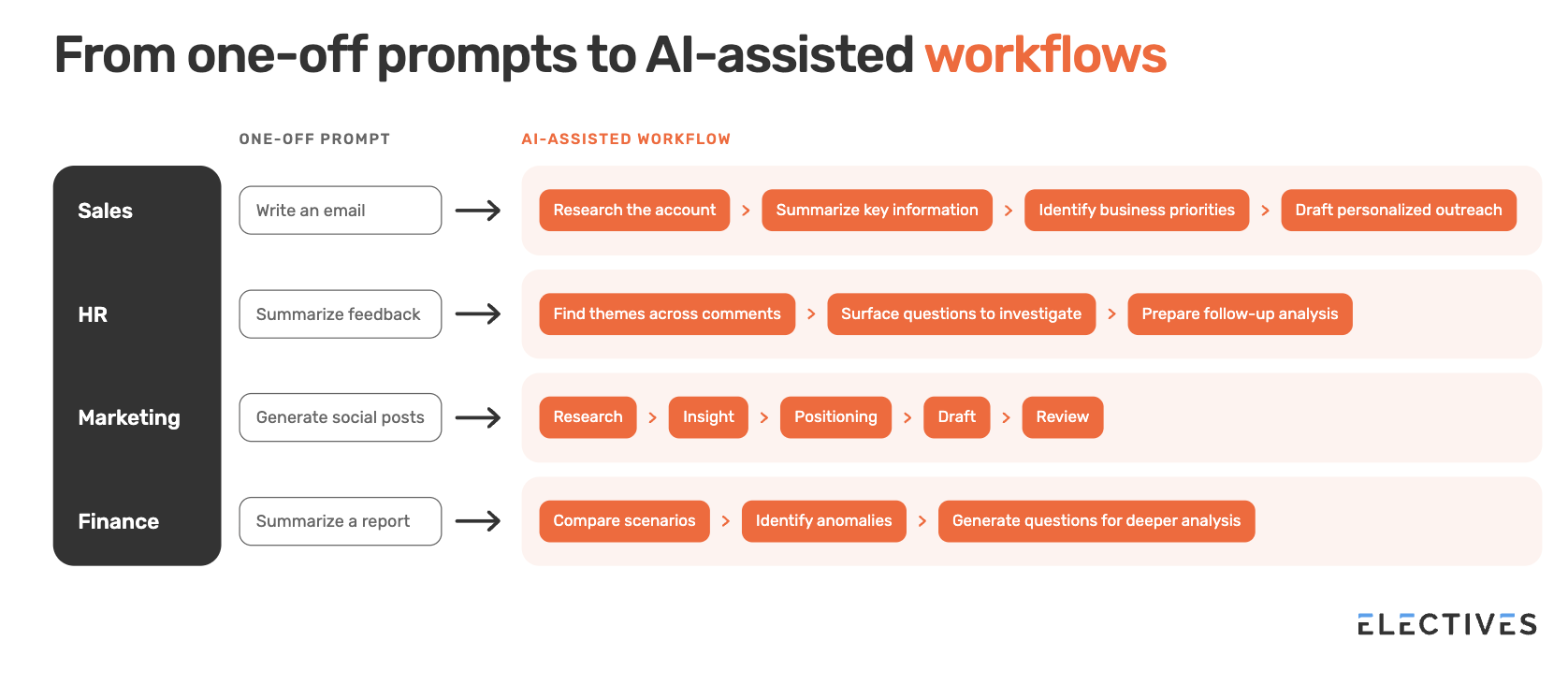
Beyond knowing how to use AI, the skill is knowing how work gets done well enough to redesign it.
That is why workflow thinking will be one of the most in-demand AI skills 2026.
4. AI evaluation and critical thinking
This may be the most underrated skill on the list.
AI can produce an answer quickly. That doesn't mean the answer is right.
Employees need to know how to evaluate AI output rather than automatically trust it. Otherwise, you will quickly see an uptick in AI work slop.
That means developing the ability to:
- Check facts
- Identify unsupported assumptions
- Recognize missing context
- Compare multiple outputs
- Test recommendations
- Identify bias
- Determine when human review is required
- Understand the consequences of getting an answer wrong
As AI becomes more capable, judgment becomes more important, not less.
This is particularly important for high-stakes work. If AI helps draft a brainstorming document, an imperfect answer may not matter much.
If AI helps inform a financial decision, legal recommendation, hiring decision or customer communication, the standard needs to be much higher.
The best training therefore shouldn't only teach employees how to generate. It should teach them how to question, evaluate and improve.
5. AI agents and automation
The next evolution of using AI at work is moving beyond asking a chatbot a question.
AI agents can increasingly handle sequences of tasks, interact with systems and help execute workflows.
That means employees will need a new set of skills.
They'll need to understand:
- What an AI agent can reasonably handle
- How to define the outcome an agent should achieve
- How to break complex work into tasks
- How to delegate appropriately
- How to provide instructions and guardrails
- How to monitor outputs
- When a human needs to step in
- How to improve an agent-powered workflow over time
Microsoft's 2026 Work Trend Index describes this shift as AI and agents taking on more execution while humans increasingly direct work, make decisions and own outcomes.
That's an important distinction. The future isn't necessarily about humans doing every task themselves.
It's about humans becoming better at directing, reviewing and orchestrating work.
That makes AI delegation a skill worth developing across the organization.
6. Human skills are AI skills, too
Here's the part that can get lost in conversations about learning AI.
Some of the most important skills for an AI-enabled workforce are actually human.
The World Economic Forum continues to identify analytical thinking, creative thinking, resilience, flexibility, leadership and social influence among important workplace capabilities. That’s because AI changes the value of human contribution.
If AI can produce ten ideas in seconds, the valuable skill may be knowing which idea is worth pursuing.
If AI can summarize a meeting, the valuable skill may be knowing what the team should actually do next.
If AI can draft a strategy, the valuable skill may be understanding the customer well enough to recognize whether the strategy makes sense.
If AI can generate an answer, the valuable skill may be knowing whether it is the right answer.
AI makes certain forms of production cheaper.
That makes judgment, creativity, communication, problem-solving and relationships even more important.
The strongest AI workforce goes beyond hiring the most technical employees. It's one where people and AI each do the work they're best suited to do.
Top AI skills to learn in 2026
So, if you're building an AI skills framework for your organization, here's a practical starting point:
For specialized technical roles, the list gets deeper.
The top AI and machine learning skills in demand in 2026 can include areas such as machine learning, data science, model development, natural language processing, AI engineering, data engineering, AI security and model evaluation.
But that's a different learning problem from building AI fluency across a 2,000-person company.
Trying to give everyone the same AI curriculum is usually a mistake.
How to build AI skills at work
Knowing which AI skills are in demand is one thing.
Building them across an organization is another.
The best approach is to treat AI capability building as an ongoing workforce strategy rather than a one-time training event.
Start with a baseline
Before launching a training program, find out where your organization actually stands by launching an AI assessment. They typically take employees 10 minutes to complete and the data you get back is incredibly valuable.
Ask:
- Who is already using AI?
- How frequently?
- Which tools are people using?
- Which teams are experimenting?
- Where are people confident?
- Where are they hesitant?
- What workflows are changing?
- Where are employees getting stuck?
- Where are the biggest opportunities?
- Where are the biggest risks?
You may discover that your organization doesn't have one AI skills gap.
It has five.
Your marketing team may be highly fluent. Your operations team may be experimenting. Your managers may be unsure how AI changes their jobs. Your legal team may be focused on risk.
And some employees may barely know where to start.
That calls for different learning experiences.
Make AI training role-specific
A company-wide AI literacy foundation is useful.
But it shouldn't be the entire program.
People learn AI best when they can immediately connect it to work they actually do.
Consider building different learning paths for:
Managers
- Managing AI-enabled teams
- Coaching employees on AI use
- Evaluating AI-assisted work
- Delegating work between people and AI
- Setting expectations
Marketing
- AI research
- Content development
- Brand voice
- Campaign analysis
- Creative workflows
Sales
- Account research
- Prospecting
- Personalization
- Call preparation
- CRM workflows
HR and People
- Employee insights
- Research
- Communications
- Talent workflows
- Responsible AI
Product and Engineering
- AI-assisted development
- AI agents
- Coding workflows
- Testing
- Product thinking
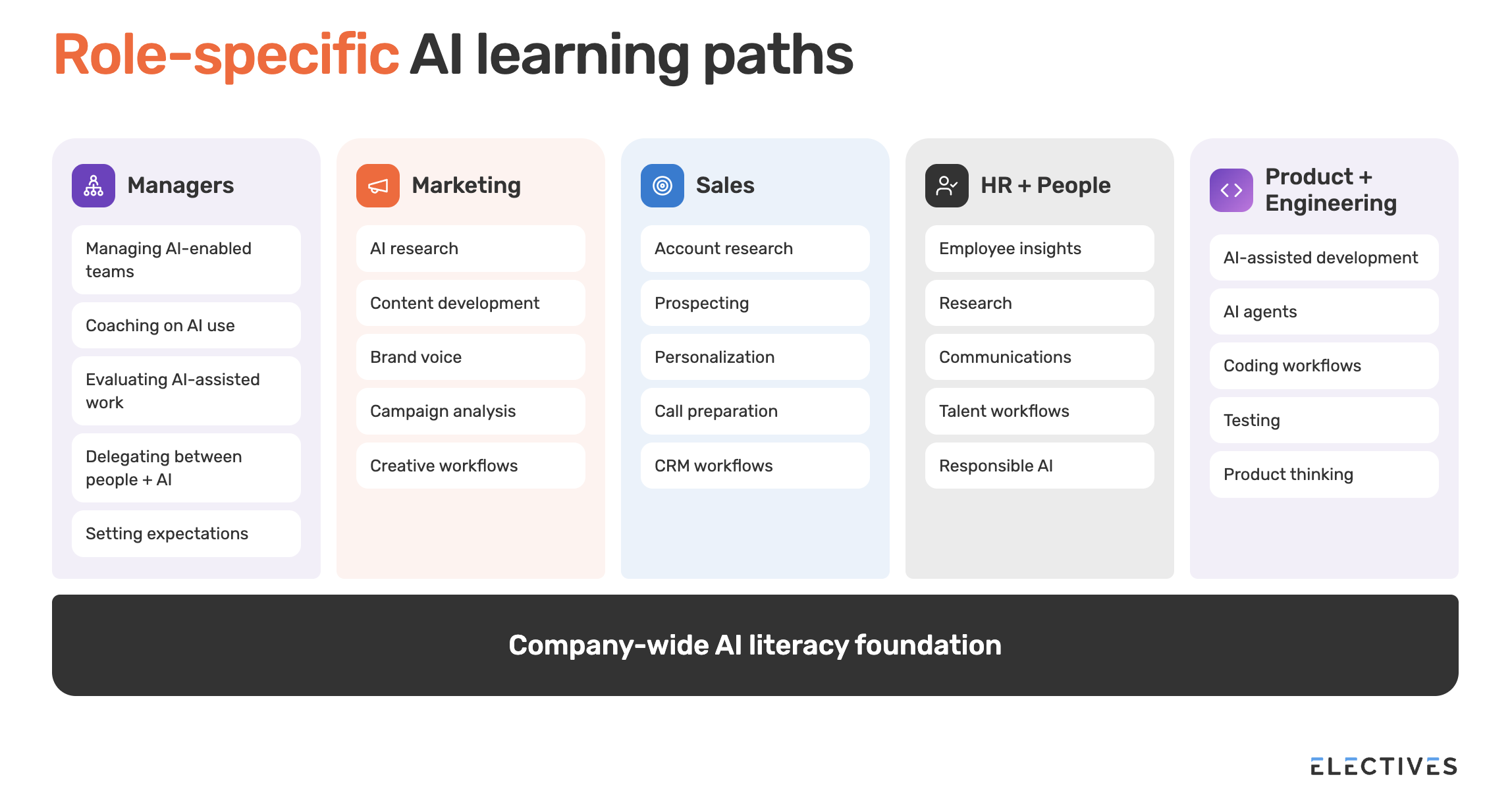
The closer the training gets to someone's actual work, the easier it becomes to turn learning into behavior.
Teach through practice, not just content
One of the easiest mistakes to make with AI training is confusing information with capability.
Someone can watch a 30-minute video about prompting and still not know how to use AI effectively.
The same person can spend 30 minutes working through a real problem with an expert and leave with a workflow they can use tomorrow.
That's why practice and live, interactive training matters.
Give employees opportunities to:
- Work on real problems
- Experiment with AI
- Compare different approaches
- Evaluate imperfect outputs
- Practice with realistic scenarios
- Learn from peers
- Ask questions
- Try again
AI skills are skills. And skills get better through hands-on practice.
Give people time to experiment
You can't ask employees to change how they work while giving them no time to figure out how.
Create space for experimentation.
That might mean:
- AI hackathons
- Team experimentation sessions
- AI office hours
- Role-specific workshops
- Peer learning groups
- Workflow redesign sessions
- Manager practice sessions
- Internal AI showcases
The goal isn't to create a company full of people who are constantly playing with new tools.
It's to create a company where people regularly ask:
"Is there a better way to do this now?"
Measure behavior change
The training shouldn't end with completion rates.
Ask what changed. Are employees using AI more often? Are they using it for more valuable work? Are teams redesigning workflows?
Are managers coaching employees differently? Are employees more confident evaluating AI output? Are people using AI responsibly?
Are new AI workflows saving time or improving quality?
Those are much more useful questions than:
"How many people installed the desktop app?"
The point of AI skills isn't access. The point is better work.
The AI skills conversation is really a workforce conversation
For People and L&D leaders, knowing the most in-demand AI skills starts with understanding your workforce.
Which capabilities will our employees need? Which jobs are changing? Which workflows should change?
Which skills should we build internally? Where do we need technical specialists? Where do we need stronger human judgment? And how do we give people enough practice to actually change how they work?
The organizations that build AI capability well won't simply teach employees how to use more AI tools.
They'll help people become better at working with AI.
That means building technical fluency alongside critical thinking.
Automation alongside judgment. Speed alongside quality.
AI capability alongside distinctly human capability.
Because the goal is a workforce that knows how to work differently now that AI exists.
And in 2026, that may be one of the most important skills of all.
.jpeg)

.jpeg)