.webp)

You've been asked to roll out AI training, and nearly every list of the best AI solutions for corporate training was written by a company selling one. Before you compare brands, decide what kind of solution you're buying. Six solution categories are sold under the same label, each solving different problems at different prices. Pick the wrong category, and you'll run a well-executed program that changes nothing about how work gets done.
Electives™ wrote this list, and we rank ourselves first against the same seven criteria as the other nine.
The top corporate AI training providers of 2026 fall into six categories. Your goal determines the category that fits, from awareness to capability to changed behavior.
The six types of AI solutions for corporate training
A per-seat content catalog and a quarter-long consulting engagement both get pitched as AI training. The gap between them can be substantial in both price and timeline, which is most of why the market feels impossible to compare.
The six categories are content libraries, learning platforms with AI features, live expert-led training, AI simulations, consulting-led enablement, and university executive education. A content library can put a policy in front of a large workforce quickly. A simulation gives someone 40 reps at a hard conversation. A consulting engagement rewrites how a function works and trains people into the new version of it. Comparing those on price per seat tells you very little.
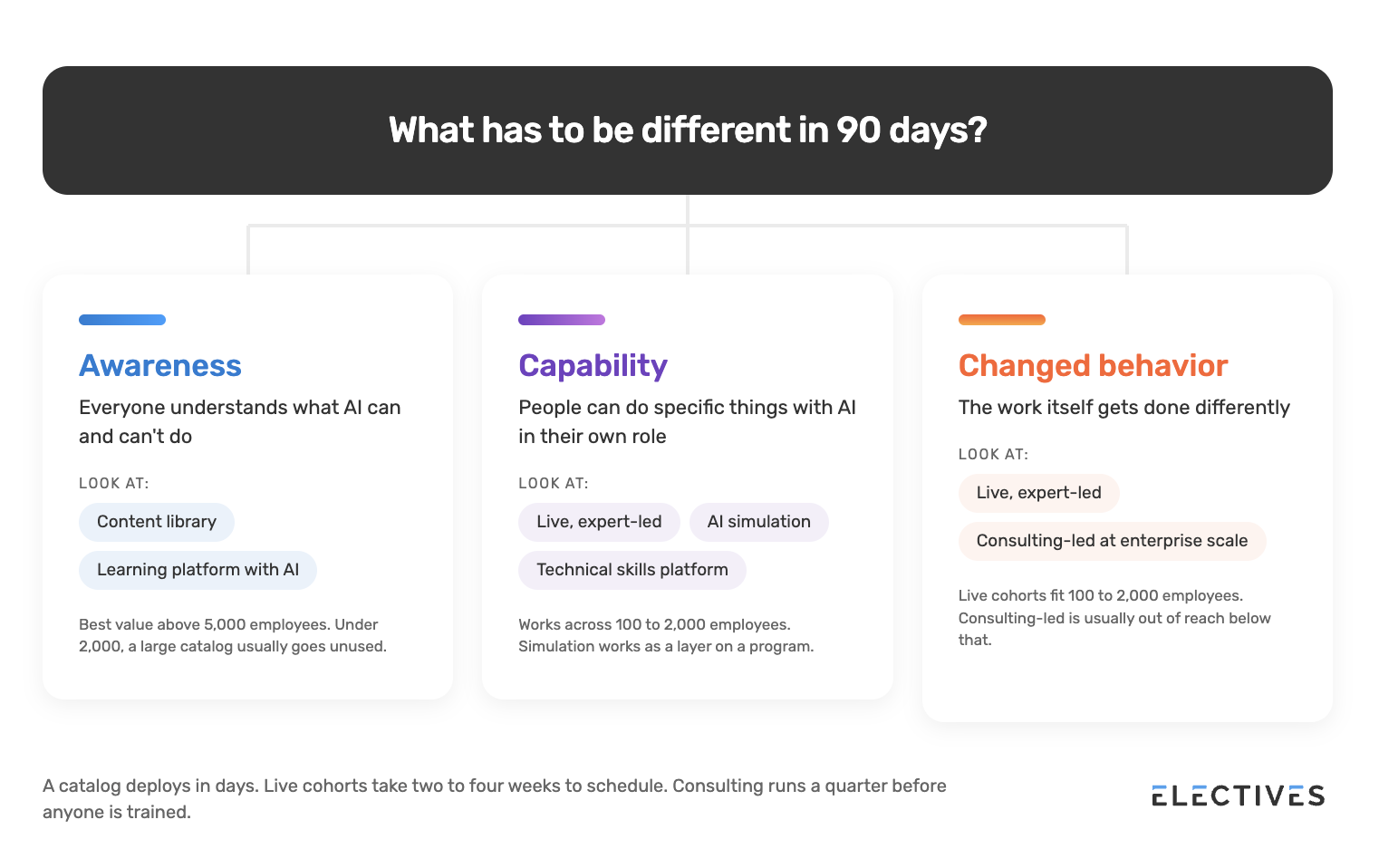
The most common buying mistake is picking a category because it’s already familiar. You own an LMS, so the training gets built there. That decision starts from what's already available. A better starting point is what has to be different in 90 days.
How we evaluated these solutions
We set the criteria before we ranked anyone, so you can see what the order rewards.
- Delivery model. Whether sessions run live with an expert in the room or as self-paced video. Live delivery gives learners direct interaction with an expert during the session.
- Application speed. Whether learners use the skill on real work within days, or whether it sits unused.
- Manager enablement. Whether the program reaches the managers who set the norms for their teams.
- Measurement and baseline. Whether the provider gives you a starting measurement and a measurable change alongside completion data.
- Instructor bench. Who teaches, and whether they’ve done the work they teach.
- AI fluency and human skills. Whether one provider covers both, or you buy the second half elsewhere.
- Breadth and cost at scale. What it costs to reach everyone, once the priority roles are covered.
These criteria favor behavior change over content volume. If your goal is broad awareness at the lowest possible cost per seat, weight them differently and start from the categories table above.
Top corporate AI training providers of 2026
These corporate AI training providers are ranked against the criteria above, so an entry lower down may still be your best buy when its category fits your goal. Every one has a trade-off line, ours included.
1. Electives — live, expert-led classes
Best for: companies of 100 to 2,000 employees that need AI use to change how work gets done
Electives has 300+ vetted instructors across different backgrounds and covers AI fluency alongside skills such as judgment, communication, and decision-making. One provider, one contract and one set of reporting across both halves of the problem. That gives teams one program covering both AI skills and the human skills that support adoption.
Classes give learners opportunities to practice with an instructor and apply concepts during the session. Managers get their own enablement, so the person who decides whether a new skill survives contact with the workday is inside the program from the first session. That combination is what moves a class from something employees attended to something the team does differently on Monday.
Programs are measured on behavior change. 92% of learners change their behavior and 98% apply new skills within a week. Reporting shows an admin who joined, what shifted and where the gaps still sit, which is the evidence a CFO asks for when the renewal comes up. The platform supports scheduling, invitations and program logistics, reducing the administrative work required to run a larger program.
Trade-off: live delivery costs more per learner than a content catalog, and there’s a size above which scheduling live classes for everyone stops making sense. For an organization whose goal is compliance coverage at the lowest possible seat price, a catalog is the correct purchase.
2. Section AI — live, expert-led classes
Best for: enterprises that need AI fluency across a whole workforce and proof of what the spend returned
Section sells the layer between buying AI tools and changing how work gets done. Transformation planning sets the strategy and names an owner for every initiative. Live working sessions move execs and managers from AI-aware to using AI in their own work. Per-employee coaching reaches further than a consulting bench can staff. A dashboard shows which AI platforms people use and where the money goes, shadow spend included. Senior operators embed with teams to run change programs and redesign work with agents. A CFO can read the output as easily as a CHRO.
Trade-off: the scope is AI and only AI. Teams that also need broader management, communication or human skills training may need additional training resources.
3. Hone — live classes with AI practice
Best for: companies whose main gap is manager capability
Hone pairs live, expert-led workshops with AI-powered coaching. The work covers three outcomes: teams that adopt AI and lead through disruption, managers who can drive their team's performance, and workplace skills across the wider employee base. Classes run in cohorts, and the AI coach fills the gap between sessions, so a manager can rehearse a hard conversation before holding it.
Trade-off: Hone has a strong manager and leadership focus. Teams looking primarily for individual contributors to build role-specific AI skills may need a more specialized program.
4. Correlation One — consulting-led enablement
Best for: Fortune 500 and public-sector organizations with a technical workforce
Correlation One writes every program from scratch for the client, matching curriculum to the industry, the technology stack and the roles the organization finds hardest to fill. Practice work runs on company-specific projects and named career tracks, so what learners produce belongs to the business. The expert network is deep and the client list runs to Amazon, Target and the US Department of Defense.
Trade-off: it’s an enterprise model at enterprise prices. The model is highly customized, which may suit organizations that need role-specific enterprise programs more than teams looking for a standardized rollout.
5. Pluralsight AI Academy — technical skills platform
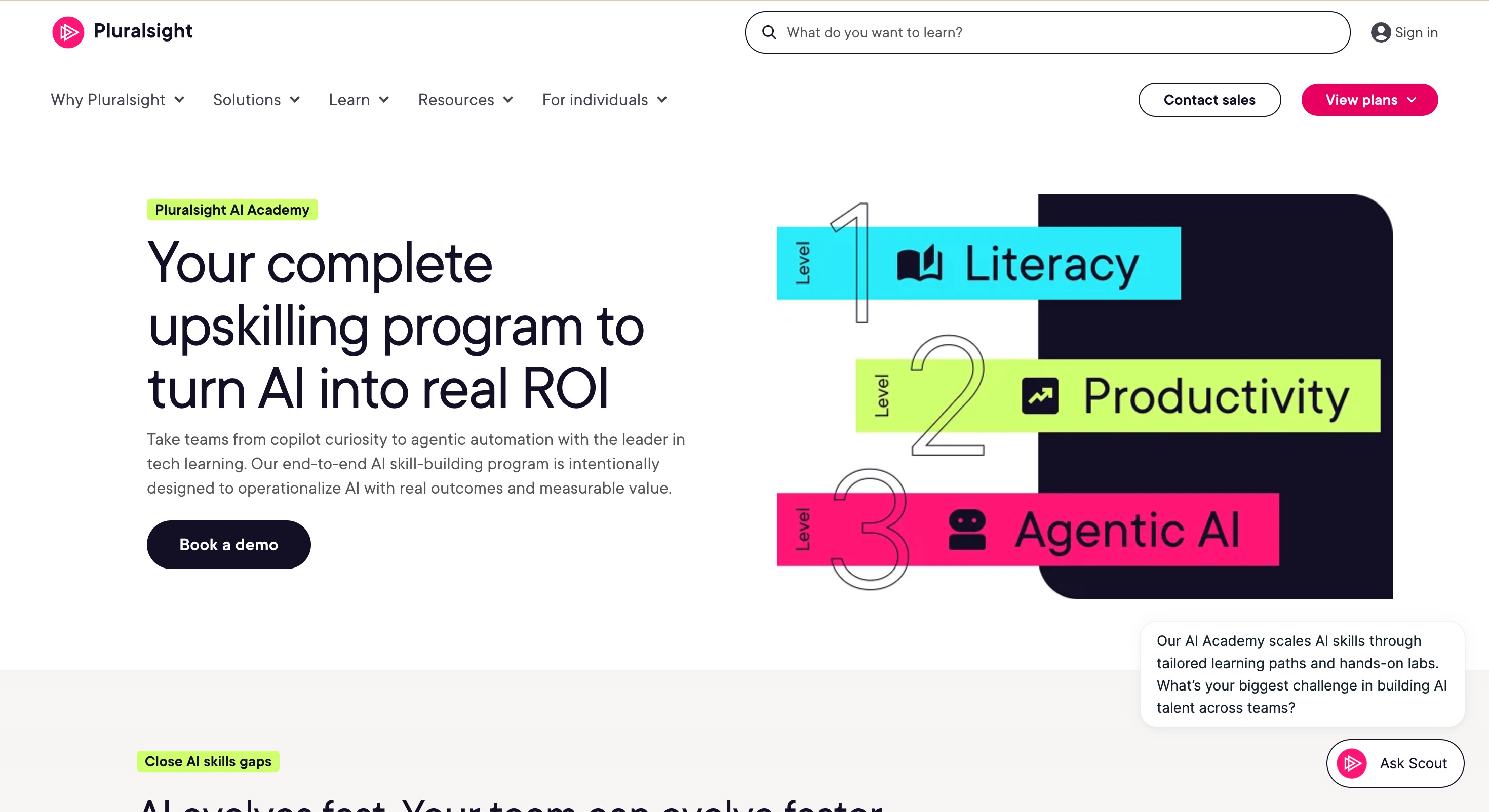
Best for: organizations whose AI ambition ends in engineering work
Three levels run from AI literacy through AI productivity to agentic AI. Each one pairs on-demand paths and labs with a live seminar. Skill assessments open the program, so there’s data on what people know before anything gets scheduled. A dedicated program manager runs the cohorts, the reporting, and the adoption comms.
Trade-off: the program ramps toward production-grade agent work, so an organization that will never build one is buying three levels to use the first. The program combines on-demand learning with live seminars, so teams looking for primarily cohort-based practice may prefer a different delivery model.
6. Go1 — content library
Best for: large workforces needing wide AI literacy coverage fast
Go1 pulls catalogs from many providers into one subscription, which puts it on most shortlists of the best corporate AI literacy training providers in the US when the goal is breadth. Its own AI layer works on the administrator's side of the problem: search that reads a stated requirement, chat that surfaces recommendations across the full library, previews of learning outcomes before you commit, and alerts when material you assigned is retiring. Human content experts still sit behind the curation.
Trade-off: Go1 provides broad content coverage and measurement, while teams looking for highly interactive live practice may prefer a live cohort model.
7. Learnit — live tool training
Best for: teams that need hands-on capability with a specific AI tool
Learnit has taught instructor-led workshops since 1995 and sells access as a team subscription, so a group works through hundreds of live and on-demand classes on one pass instead of buying workshops one at a time. Facilitators teach live and interactively, and the AI work is hands-on in the tool itself, so people leave able to do a specific thing in a specific product on Monday.
Trade-off: capability anchored to a named tool travels with that tool. When the organization switches products or the vendor redesigns the interface, some of what was learned has to be taught again.
8. Exec — AI roleplay simulation
Best for: revenue teams and the managers who coach them
Exec connects to your call recorder and scores real customer conversations against rubrics you write, then surfaces patterns across a team so coaching goes where the gap is. The roleplay side gives reps and managers AI personas that push back and handle objections, available for another attempt at a hard conversation whenever someone wants one. Roleplays, call scoring, the learning platform and coaching sell as separate modules or as a stack.
Trade-off: the ground here is conversation, mostly customer-facing. It sharpens a skill someone has already been taught, which makes it a strong complement to instruction and a poor substitute for it. A workforce-wide AI program is a separate purchase.
9. Docebo — AI-native learning platform
Best for: organizations needing AI-powered learning infrastructure.
Docebo runs learning at scale for employees, customers and partners on one platform. Skills Intelligence infers what people can do from activity in the system and shows where the gaps are, so a program starts from evidence. Enterprise Knowledge answers questions at the moment someone is stuck. AgentHub puts agents to work on tasks. For a company whose expertise already sits in-house and lacks a way to deliver it, that combination does real work.
Trade-off: Docebo sells the infrastructure and expects the curriculum to come from you or from a content partner.
10. Coursera and Udemy — course catalogs
Best for: broad self-serve coverage, with a credential at the end for the people who want one
Coursera carries programs from universities and companies a hiring manager recognizes, and its business tier sells expert-led generative AI paths by role to help guide buyers. Udemy has grown past the catalog: AI starter paths split by function, skills mapping that turns a business goal into a learning path, organization-specific role play, and connectors that put course content inside the AI assistants people already have open.
Trade-off: completion is the unit of measurement on both platforms, alongside assessments and credentials. An assessment shows what someone knows and a certificate shows they finished. Whether the work changed is a separate question, and a catalog isn’t arranged to answer it.
Also worth considering
- Skillsoft — a broad enterprise catalog spanning leadership, technology and compliance, with CAISY, an AI simulator where employees practice real-world scenarios.
- Multiverse — AI and data upskilling delivered as apprenticeships that run inside the job, pairing expert coaching with AI support.
- BetterUp — human coaching across executives, managers and the wider workforce, with AI coaching that reaches people inside Slack, Teams and Workday.
- Degreed — a learning experience platform that pulls content from thousands of sources and connects people to internal projects, gigs and mentorships.
- MIT Sloan and HBS Online — executive education with credential and network value, MIT Sloan leaning analytical and technical, HBS Online running asynchronous case cohorts.
- BCG X — BCG's build arm, where technologists and data scientists embed with a client to ship working AI systems, enablement included.
How to choose a provider
The right category still leaves you with the wrong provider more often than not. Most corporate AI skill development training providers are sold to companies of a particular size, with a particular budget and a particular amount of internal capacity to run the thing. Miss on any of those and the fit stops mattering.
Company size
As workforce size increases, the economics often favor broader self-paced coverage alongside live training for priority roles and managers. A large catalog gets bought and then sits there, because nobody's job is to make people open it. That size buys live training for the roles where AI use has to change, and platform access for everyone else.
Above 5,000, the pricing flips. Per-seat catalogs get cheap enough to cover the long tail, and live sessions go to priority roles and managers. Between the two, it comes down to whether AI use is concentrated in a few hundred people or spread across everyone.
What you already own
An LMS that needs a curriculum is a content problem. An LMS nobody administers is a staffing problem. Companies confuse the two and end up in a platform evaluation that takes a quarter and ends in a migration.
Before any vendor call, check if yours can host or link to outside content, whether it reports at the level your leadership asks about, and whether anyone is running it today.
Timeline
A catalog can usually be deployed faster than a live cohort program. Consulting engagements typically require more planning before training begins.
Start from the date that's forcing the purchase. A short deadline can rule out a more customized engagement.
Who runs it internally
A program that assumes a full-time coordinator will stall on a two-person people team, usually around week three, when the scheduling and the chasing arrive at once.
Ask every provider for the internal lift in hours per month, and who handles reminders, reporting and rescheduling. A provider that has done this before answers with a number.
Why most corporate AI training doesn't change how people work
Most programs deliver exactly what was bought. People attend, the platform reports high completion, and the tools stay open on everyone's desktop. Six months later the work looks the same. Three things account for most of it, and none of them are visible while the program is running.
1. Training stops at the tools
A prompt tutorial written against last spring's interface is already wrong in a few places. The menu moved, the model got better at some things and worse at others, and the exact sequence someone memorized no longer matches what's on screen. That's a quarterly rewrite, and most catalogs don't keep up.
The part that holds its value is narrower and harder to teach. Which tasks are worth handing over at all. What a confident wrong answer looks like in your own domain, where you have enough context to catch it and a general audience wouldn't. When checking the output costs more than doing the work yourself. How much of a client-facing draft can come from a model before someone has to own it line by line.
Those aren't tool questions and they don't have general answers. A finance team and a support team draw the lines in different places, which is why the ones that get drawn well usually come from working through real cases with someone who has made the call before.
2. Managers get skipped
Look at who gets scheduled in a typical rollout. Executives get a strategy session. Individual contributors get access and self-paced training. Managers get the announcement email and a line in the deck about reinforcing adoption on their teams.
Then the decisions start, and they all land on the manager. Someone spends an hour learning a new workflow instead of clearing their queue, and the manager decides whether that hour counted. AI-assisted work shows up in a review, and the manager decides whether it reads as resourceful or as cutting corners. A sprint slips, and the manager decides whether practice time is protected or the first thing cut. None of that is in the rollout plan. Most of it is settled within two weeks of launch, and it sets what the team believes is expected.
Untrained managers tend to land on tolerance. AI use is allowed and nothing depends on it. Nobody gets discouraged, nobody changes, and six months on the license count looks healthy. It never registers as a failed program, which is why it goes unexamined and gets repeated.
The fix runs ahead of the main rollout: managers get their own version first. What good output looks like in their function, how to raise it in a one-on-one, what to say when someone submits work a model clearly wrote, and what they're accountable for once their team has access. It costs a fraction of the wider program and it decides whether the rest of it takes.
3. There's no baseline
Ask what a program achieved and the answer often centers on attendance, completion and satisfaction. All three describe the program. None of them describe the work. The reason it stops there is that nobody measured anything before it started, so there's nothing to compare against.
You can't tell whether the people who improved were already the strongest, which is the difference between a program that worked and a program that attracted the willing. You can't tell which teams started furthest behind, so the same content goes to everyone and half the room is bored. And when someone senior asks whether it was worth the spend, the honest answer is that it seemed to go well.
The timing matters more than the instrument. A baseline collected two months into a rollout is already measuring a changed group.
How to measure whether AI training works
The four measures below get collected at four different points, from the week before the program starts to a quarter after it ends. Two of them cost almost nothing and can be running by the end of the first session.
- Baseline and delta. Run an AI fluency assessment before anything is scheduled, then again after. The distance between the two is the result. This is the only measure that survives the question "compared to what," which is where most program reporting falls apart.
- Application within a week. Ask whether people used the skill on real work in the first seven days. One question, sent once. Nothing else you can collect that early predicts as well, because a skill that goes unused inside a week usually stays unused.
- Manager-observed change. Ask managers whether their team's work changed, and in what way. Two or three questions a month after the session. Managers see the output, so they can see improvement better than what learners report about themselves, and it costs a few minutes per manager to collect.
- Workflow-level output. Hours reclaimed on a named process, or cycle time on one that runs often enough to measure. Slower to gather and it needs a process owner's cooperation, but It gives leadership a business-level measure to review when the program comes up for renewal. Pick one workflow and measure it properly instead of estimating across ten.
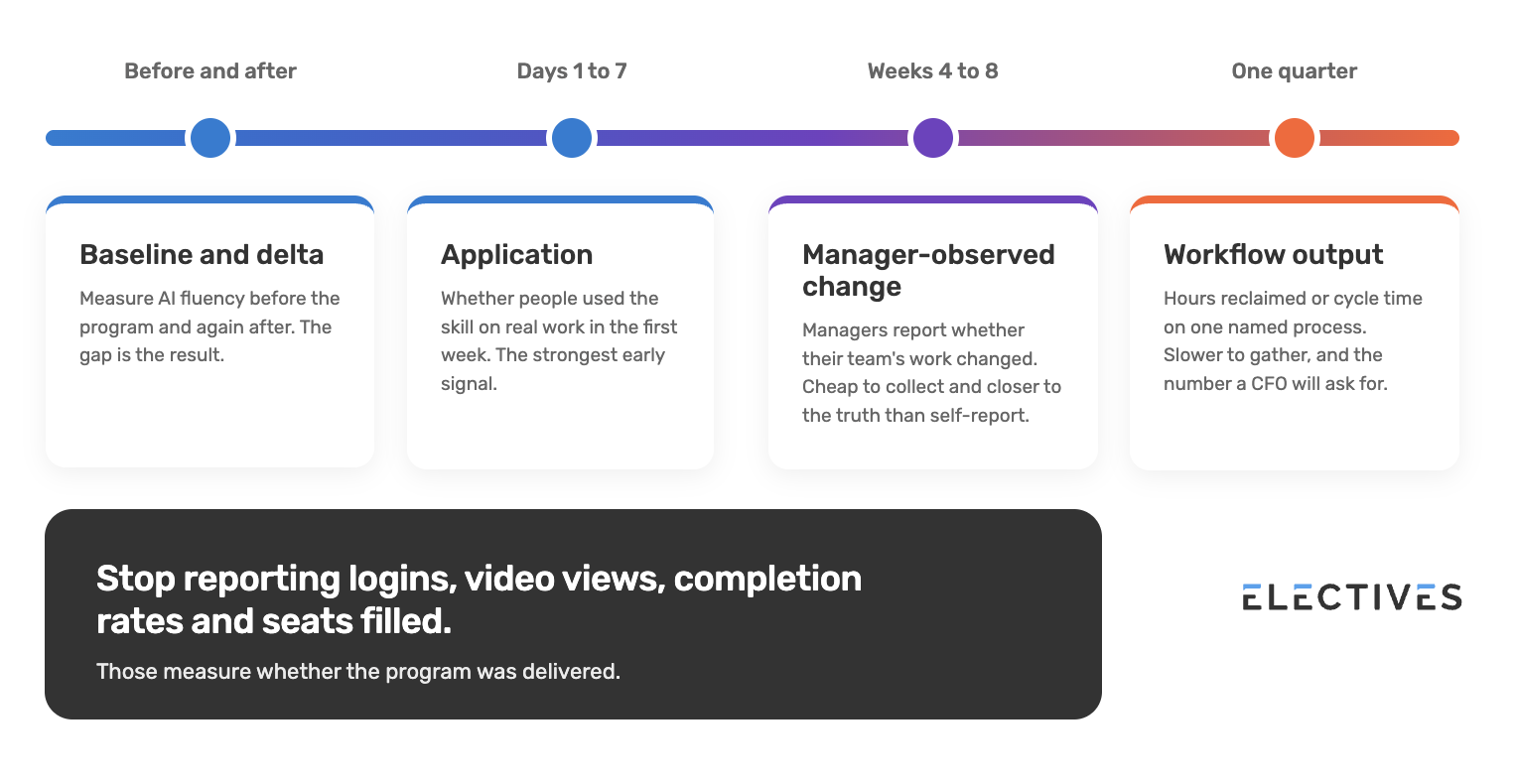
What to stop reporting: Logins, video views, completion percentages and seats filled all answer the same question, which is whether the program was delivered. That was never in doubt. The question is whether the work changed, and none of these four gets any closer to it.
Choosing the right AI training partner
The vendor shortlist is the second decision. The first is which category the goal calls for, and getting that one wrong is expensive in a way no amount of vendor diligence recovers. A catalog and a cohort program both look reasonable in a demo. Only one of them matches what has to be different in 90 days.
Electives sits in the live, expert-led category. Vetted instructors teaching real classes, AI training alongside the human skills that decide whether AI use holds, managers enabled ahead of their teams, and reporting on whether behavior changed rather than whether people showed up.
.jpeg)



.jpeg)