
People use the term AI change management for two things: using AI tools to run change programs and managing the organizational change that comes with adopting AI. This article covers the second: the human side of an AI rollout.
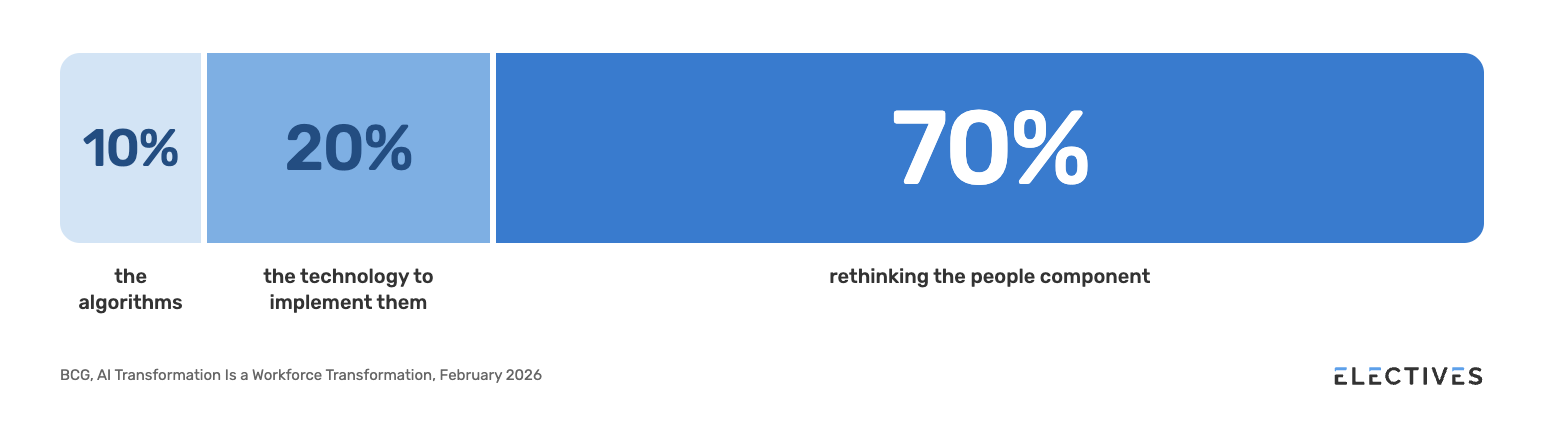
That side carries most of the value. Across its work with hundreds of companies, Boston Consulting Group puts about 10% of AI’s value in the algorithms, 20% in the technology to implement them and 70% in rethinking the people component. So far, only about 5% of organizations have seen substantial financial gains from AI.
That 70% is the part a software rollout can’t deliver on its own. It depends on how people learn, what they feel allowed to try and whether their managers make AI part of how work gets done.
Below, we cover what the discipline involves, why the standard playbook partly misfires on AI, how managers carry the change, what to do instead, how to handle resistance and fear and how to tell whether it’s working.
What AI change management involves
AI change management is the process of preparing, equipping and supporting people through the shift to working with AI, so individual use becomes shared capability. It covers what people are expected to do with AI, what they’re allowed to do and who helps them get there.
BCG splits the 70% people component into four areas:
- Strategic alignment from the top. Leaders agree on a short list of AI priorities, usually three or four, and back them with governance and clear success metrics. That keeps AI work tied to what the business needs.
- Adoption and behavior change. People get a clear reason to use AI, guardrails they can trust and training that builds fluency. The goal is moving them from early experiments to changing daily work.
- Workforce impact. Leaders map how AI will change roles and skills, then name the gaps. Upskilling, reskilling and targeted hiring close them.
- An operating model built around AI. Roles and team structures get redesigned for people working alongside AI. So do the workflows, so new habits have somewhere to stick.
Implementation and adoption often get treated as one project. Separating them shows what AI adoption is and where change management fits. Implementation means getting AI tools deployed, and it ends: licenses go out, access is set up and the project closes. Adoption means people using AI until their work changes. It has no end date, and it’s where change management does its work.
If about 70% of AI’s value depends on how people work, a program that spends nearly all its budget on licenses and integration is paying for the smaller share of the return.
Licenses and integration usually come with an IT owner, a project plan and a deadline. The people side needs its own budget, owner and progress measures. Without them, it falls between HR, IT and the business, and nobody moves it forward.
In BCG’s research, the roughly 5% of organizations seeing substantial financial gains from AI also have three-year total shareholder returns about four times higher than AI laggards, on average.
In McKinsey’s State of AI 2026 survey, 80% of respondents say AI has improved their own productivity. Only 37% say AI has contributed to their organization’s EBIT. That share has barely moved in a year, even as more organizations scale AI across the business. The individual gains are real, and most of them aren’t reaching the company’s results.
Closing that gap is the work of change management: turning one person working faster into a team producing more.
Why standard change management misfires on AI
Standard change management assumes a known destination. With a new CRM, a reorganization or a new process, leadership can describe the end state, train people toward it and measure when they’ve arrived. Most advice on AI and change management starts from the same assumption. It doesn’t hold for AI, for three reasons.
There's no fixed end state.
AI tools change every few months, and the most useful applications come from the people doing the work. A team that started with a writing assistant in January may be handing whole reports to an agent by June, and nobody planned that in advance. A standard program ends once the change is in place. AI needs support that keeps going.
The problem usually isn't resistance.
Change programs usually focus on winning over people who don’t want to change. With AI, most employees are already using it. In Slack’s 2025 Workforce Index, daily AI use among desk workers rose 233% in six months. In an earlier Slack survey, 48% said they’d be uncomfortable telling their manager they used AI for common workplace tasks. PagerDuty’s 2026 Shadow AI Survey of office professionals at large companies found 39% would rather use AI without telling anyone, and 29% of those using AI for work aren’t sure their use is allowed. Bringing that use into the open and guiding it is different work from convincing people to start.
Communicating the change doesn't produce the change.
Change programs usually rely on policies and launch emails. With AI, people need permission they believe and the skills to use it. A policy that says AI is allowed won’t help someone who still worries how their manager will react.
Here’s how the two compare:
In BCG’s research, 88% of managers at future-built companies use AI themselves and work it into their decisions and daily operations. At AI laggards, it’s 25%. Employees at the future-built companies see AI as something their direct manager uses every day.
The managers expected to lead this change are also having a harder time with AI than the executives above them. In McKinsey’s 2026 survey, 47% of mid-level managers and individual contributors report at least one negative effect from AI use, compared with 31% of executives and senior managers.
That matters because managers make two calls no one else can. First, a manager decides whether AI use on their team is expected, tolerated or frowned on. Second, managers are the people most likely to notice when someone on the team finds a faster way to do a task. They can ask that person to show the others, make the new approach part of how the team works and check a few weeks later that people still use it. That’s how one person’s gain becomes the team’s. Nobody else in the organization sees the team’s daily work closely enough to do it, and repeated across every team, it’s how you build an AI-enabled workforce. It also means AI training for employees needs to reach managers, who field most of their team’s questions about what’s allowed and what works.
Teams also move at different speeds. Legal and finance work under risk limits that marketing doesn’t face. Engineering is often ahead of any company program. One program rolled out the same way everywhere ends up wrong for most of these teams.
In practice, change management for AI adoption across teams means three things:
- The same expectations everywhere, such as when AI use is encouraged and what data never goes into it.
- Specifics set by each function, so legal’s rules can be stricter than marketing’s.
- Managers accountable for AI use on their own team, with the central team in a support role.
Change management for AI adoption: what to do
By the time most companies start planning, their people are already using AI, often without telling anyone. The change management tips for AI adoption below start from there and run in order. They cover the people side of a rollout and work alongside the AI adoption strategies you choose for the tools themselves.
1. Find out where people are now
Before planning anything, ask people what they already use AI for, which tasks they avoid it for and whether they think they’re allowed to use it at all. Keep the survey anonymous. People hiding their AI use won’t report it under their name. An AI readiness assessment framework gives you a structure for the questions, so you can compare the results when you ask again later.
2. Make permission specific
Name the approved tools, the data that can and can’t go into them and the tasks where AI use is expected. Fit it on one page, written plainly enough that people remember it without looking it up. Then have managers walk their teams through it, so people hear it from someone whose opinion of their work matters. A long policy document tells people what’s banned. It rarely tells them what’s encouraged.
3. Train managers first
Managers need to answer their team’s questions and use AI in their own work before the wider rollout starts. Getting the same slides a week early won’t prepare them for either. Give them time to use AI on their own tasks, practice the conversations they’ll have with their team and clear answers on what they can approve. That includes the moment someone admits they’ve been using AI without telling anyone.
4. Protect time to practice
People need time on the calendar to try AI on real work. In BCG’s research, future-built companies are four times more likely than laggards to have structured AI-learning programs and protected time for employees to learn. They also plan to upskill more than half their employees on AI, compared with 20% at laggards. Put the time on calendars, and ask managers to protect it when deadlines get tight.
5. Teach people to judge the output
BCG splits AI skills into two groups. Foundational skills include prompt writing and AI literacy. Core skills include contextual judgment, framing problems and interpreting results. Prompting habits change with each new tool. Knowing when an answer is wrong, or when the question was wrong to begin with, carries over to whatever tool comes next. Give the core skills most of the practice time.
6. Keep it running
Set a schedule that continues after launch. Hold a monthly team check-in where each person shares one new way they’ve used AI. Update the permission page every quarter. Rerun the first step’s survey at regular checkpoints, covered in the measurement section below. The tools will change again, and each change brings new questions about what’s allowed and what’s worth trying.
How to handle resistance and fear
The usual answer to AI anxiety is one message: AI won’t replace you. That speaks to job security at best. People worried about bad output, looking incompetent or losing control of their work hear nothing that applies to them.
Job security. Vague reassurance sounds like evasion. Tell people plainly that the work will change, which tasks are likely to change first and what support they’ll get along the way. This is the workforce-impact area from BCG’s four, and it needs a real plan behind it.
Trust in the output. Someone who’s been burned by a confident wrong answer is reacting reasonably. Show them how to check AI output: what to verify, what to compare it against and when to stop using AI for a task. That’s the same judgment from step five, applied to the person who trusts AI least.
Looking incompetent. This one rarely gets said out loud, which is why it lasts. In Slack’s research, desk workers who’d be uncomfortable telling their manager about their AI use gave three main reasons. 47% felt it was cheating, 46% worried about looking less competent and 46% worried about looking lazy. Managers can change this by asking about AI use openly in team meetings and talking about it as a skill people are building.
Losing autonomy. People who take pride in their judgment don’t want it handed to a tool. Ask them where AI would help their work and where it wouldn’t, and let their answers decide where it applies first.
Senior people talking about their own AI use changes all four concerns faster than any company message. That means naming the tools they use, what they use them for and what went wrong. When a director tells the team an AI summary got a client’s numbers wrong last week, everyone learns that mistakes are expected and that checking is part of the job.
How to measure AI change management
Licenses issued, logins, prompts sent and training completions are easy to count, and all four measure delivery. They show that the program ran. Whether anyone works differently needs other measures.
The last row is the easiest to skip and the most important here. It shows whether one person’s discovery reached the rest of the team, which is the gap this whole effort exists to close.
Take the first measurement before anything starts. An AI fluency assessment works for this, since it’s anonymous and you can rerun the same questions later to see what changed. Then measure again at 30, 90 and 180 days.
- At 30 days, look for early signs: people using what they practiced and managers bringing up AI in team meetings.
- By 90 days, applied use and manager-observed change should be moving.
- At 180 days, look at spread.
Compare each round against your own baseline. An industry average mixes companies of every size and starting point, so it can’t show whether your people moved.
Where to start
If you’re deciding what change management is needed for AI adoption, start in this order: find out where people are, make permission specific, train managers first and keep measuring whether new practices spread.
Electives™ helps with the people side. We start with your managers and run live, expert-led classes with vetted Electives instructors, then measure success by behavior change. Our live AI training pricing covers everything from programs for select teams to company-wide rollouts.