


.webp)
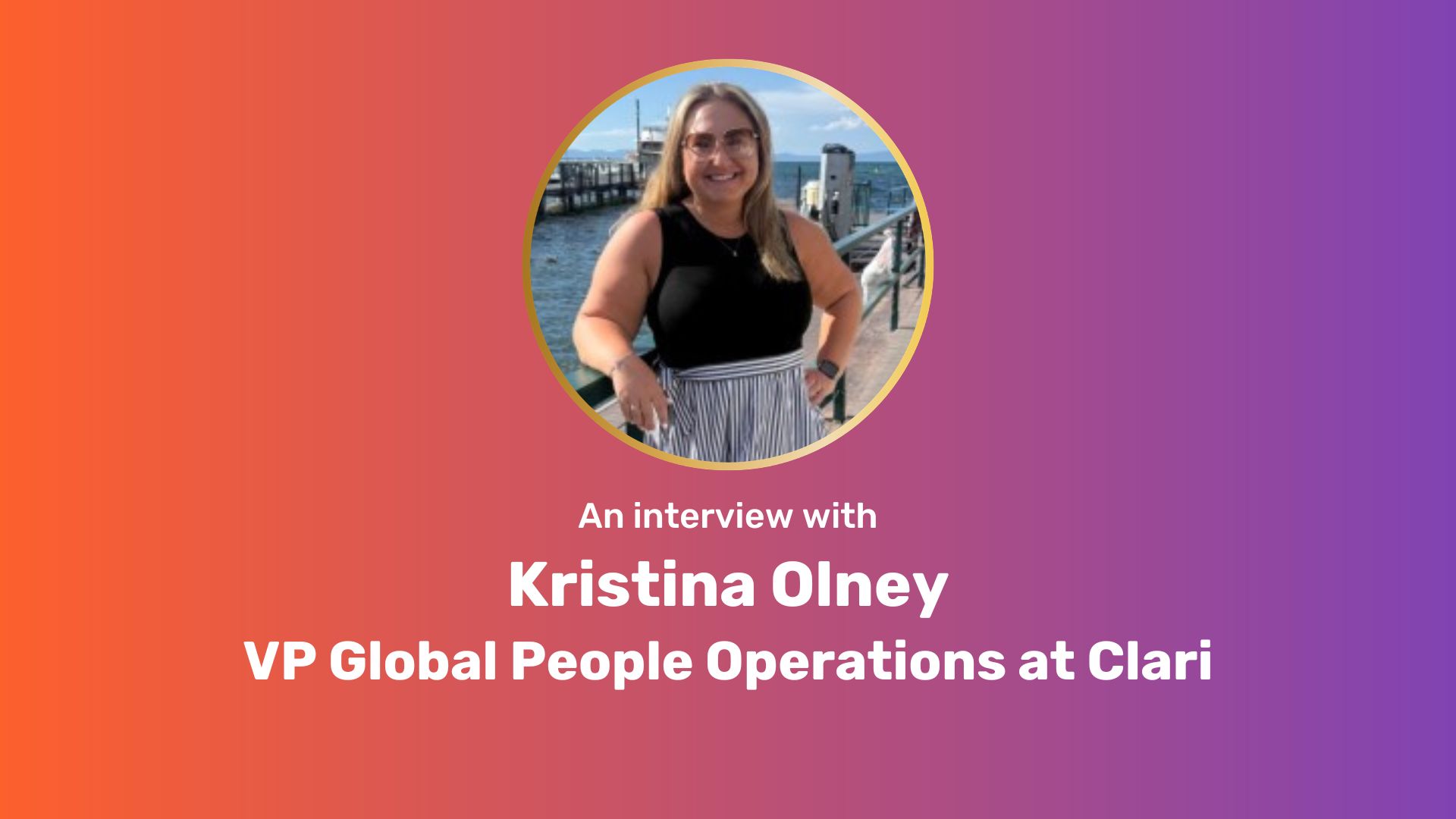
Insights from Kristina Olney, VP Global People Operations at Clari
Electives Co-Founder Jason Lavender sat down with Kristina Olney, VP Global People Operations at Clari, to learn how she's building people-first development programs, why AI verification matters more than AI adoption and what makes modern learning stick. The result? A conversation about finding the right leader to learn from, training managers before they have the title, and meeting people where they are.
Key topics covered:
- Why HR having a seat at the table changes everything
- The importance of training managers before they become managers
- How AI verification is replacing AI adoption as the priority
- What Kristina learned from working with an incredible CPO
- Why modern learning means meeting people where they are
From the Easter Bunny to VP of People Operations
Kristina's career started early—at 13, working as the Easter Bunny and in a sales capacity. By 16, she was managing a sales operation. While in college at Sonoma State, she ran the fantasy photo operation at the San Francisco Giants and worked with Major League Baseball for the All-Star Game.
"I got a lot of really cool experiences that somebody at my age at that time probably didn't get to have."
She graduated in 2009, one of the historically worst years to graduate. After being furloughed and eventually losing the Giants account, she started looking for what she loved most about her job: interacting with people, hiring them, training them.
That led to recruiting. First at an agency, which wasn't for her. Then a recruiter named Chris Carlucci called about a role at a company called Velti in San Francisco.
"I interviewed on my birthday, and later that afternoon, I got the job. So it was just one of those very cool experiences."
Kristina admits, back then, she didn't really know what publicly traded meant and didn’t really know software. But that started her tech career in HR.
Through multiple companies, Kristina built experience across geographies, stages and challenges.
"When I started looking again, I was looking for what's gonna be my next home. And I found Clari, talked to my boss, and I was like, ‘Yes, that's who I want to work for.’ She had a wealth of experience, that's the person I'm going to go and learn from to get to where I want to go eventually."
Learning from an incredible CPO
When Kristina joined Clari, she knew she wanted to work for Laura, the company's CPO. Five years later, she reflects on what she's learned:
"I have had complete autonomy, to do what I need to do to make decisions on behalf of the company, to run my team and the programs I'm responsible for with her full trust. Being trusted by a leader who has worked at some very large companies, who knows a lot of people, has been a privilege."
Kristina has watched how Laura tells stories with data. How she has conversations with board-level executives. How she puts together board notes that don't come back with edits. But the most powerful learning?
"Her bringing me into the room in for things that maybe I shouldn't have been in, maybe I should have been, but gave me the experience I need to, you know, if in my next role I do choose to be a CPO, I now have those skills that I didn't have five years ago when I walked in the door."
And it wasn't just about being in the room:
"And not only did I get to be in the room, I had the authority to speak, if I had something to say, or if I noticed something or observed something. You know, sometimes you get brought in the room, but you're supposed to be a quiet observer, and I was empowered to actually have that voice amongst other people."
Laura also taught Kristina about transparency:
"[Laura] taught me that it is absolutely okay to be a transparent leader. It's one of the reasons why my team loves to work with me, because they know that I can't share everything, but if there is something to share to let them know, so that they're prepared, I'm going to do it to the best of my abilities."
HR finally has a seat at the table
When asked how HR has evolved over the last 15 years, Kristina is clear about what excites her most:
"My favorite part about the last 5 to 7 years of HR is HR now becoming a strategic partner, and not just a function. Having a seat at the table, being included in business decisions, that has definitely been something that has changed."
It's still changing. Companies are still learning how to use HR as a strategic partner. But HR is in the room now, helping make business decisions, helping put together business strategy.
And with AI, it's becoming even more important:
"We're setting strategy, figuring out how to use it, what are the, you know, parameters, what are the guidelines? What are the guardrails? How do we do it safely? How do we get employees to embrace it?"
The message Kristina wants employees to understand: AI isn't taking jobs.
"If you aren't embracing it, you aren't paying attention, you aren't learning it, that's what's going to get your job replaced. So making sure that folks understand that, too. We don't want this time period to pass you by."
From AI adoption to AI verification
Kristina recently dealt with a legal matter where the team discussed an article about a company using AI to write briefs—and the AI made up court cases.
"You can't just rely on the information that it's giving you, because it may hallucinate. So even if you're using it to write a policy, you're going to have to make sure you're reading it a couple times, and then go validate that whatever it's quoting is correct."
Kristina uses AI for drafting documents, but never stops there:
"That looks like what the law says, but that's not giving me exactly what I think I need, so I'm going to go actually talk to a lawyer and really verify that this is, in fact, how the law should be interpreted, rather than, well, it looks right, I think that's what it said."
Why? Because AI hallucinates. Or you ask a question one way, and it thinks you're asking something else.
"It's really important to make sure that what you're using it for is correct."
Train managers before they are managers
When asked what separates companies that develop talent well from those that struggle, Kristina points to people-first leadership:
"I think the companies that are doing it well right now are people-first throughout. You have a people-first CEO, people-first leaders. They want to attract and retain and grow their talent, so they're going to do everything in their power to make sure that that happens."
It goes back to HR having a seat at the table. If leadership says they want to retain people, HR asks: What are the strategies? What are we doing?
"One of those? Learning & Development. If that is missing, and you just, you know, throwing money at people helps to an extent, but if somebody's looking for a specific skill set, you've got to give them that pathway to get there."
At Clari, they train managers before they become managers:
"Somebody expresses interest in being a manager. Well, we're going to look at, and maybe they can't be a manager here right now because there's no role available, but maybe they can be a team lead. Maybe we can start inviting them to the manager-specific courses. Yes, it doesn't apply to them fully, but that's going to start to give them the skills so that when that opportunity does exist, whether it's here or somewhere else, then they've got the basics to be able to do that."
The other critical piece? Time.
"Making sure that you are building out time for folks to work on development. So making sure your managers are the ones pushing, go attend that training course, go do this, here's this resource. When it's more like you've got to hit the deadline, you've got to do this, you've got to do that, that's when we're going to see development is going to fail, because there's no time to do these things."
Teaching the basics is still critical
When discussing AI's impact on junior employees, Kristina emphasizes something important: don't skip the fundamentals.
"We need to make sure that they're validating what they're doing with AI and that, they're using the tools correctly."
And more than that:
"With AI, it doesn't just start with AI. You still have to know how to do the basic things, because what if the companies rip it out, because it's too expensive? Or if they are looking at sustainability, AI isn't actually the best thing for the environment, right?"
What if there's a shift away from AI at some point?
"And these folks haven't been developed to learn the basics? They don't know how to make their own presentation. They don't know how to deliver a presentation because they've been using AI to. We've got to make sure that earlier in career folks are still getting the same development that we got, when we were coming up in the world."
Adaptability: The skill that matters more than ever
When asked about competencies that will be needed more than ever, Kristina landed on adaptability:
"I actually like that one. I do think that adaptability is going to continue to be extremely important, because, as you said, the only thing in life that's constant is change. In our own, you know, lives and careers and things like that, we've seen evolution of phones, we've seen evolutions of tech."
This isn't the first evolution of tech. It won't be the last.
"Some things that we thought were gonna happen a lot sooner in our lives still haven't happened, but they're close. So, you know, maybe in five years, we're ready for that next thing. But being open to change, leaning into it where necessary, is going to continue to be very, very important."
Modern learning means meeting people where they are
When asked what modern training looks like in 2026, Kristina is clear: "Meeting people where they are is probably the most important thing we can do from a training perspective."
It also means learning nudges and bite-sized information:
"Making sure you're also getting people bite-sized information as follow-ups. Something that's easy, digestible and great reminders for folks, because in this day and age, people don't have a lot of time, or they don't make a lot of time, and so sometimes it's that quick hit."
Helping people find pathways
When asked what she's most passionate about, Kristina doesn't hesitate:
"I am most passionate about working with people. Whether that is, they've got something big going on in their life and they need help. They've just had a baby. They are struggling with something. They want to be advanced. Helping people find pathways for themselves is what gives me energy."
And also, learning from others:
"I truly believe that you learn something every day, and I do, when I'm interacting with other folks. Somebody always has something to teach you, and you just need to be paying attention to get those learning nuggets out of folks. But I truly get my energy from working with people."
Companies that develop talent well train managers before they need them, make time for development alongside deadlines and verify AI outputs instead of blindly trusting them. They find leaders who bring you into the room and give you the authority to speak. They meet people where they are with bite-sized learning, teach the basics even when AI offers shortcuts and help people find their own pathways instead of prescribing one-size-fits-all solutions.


.jpeg)
.jpeg)

.jpeg)