.webp)
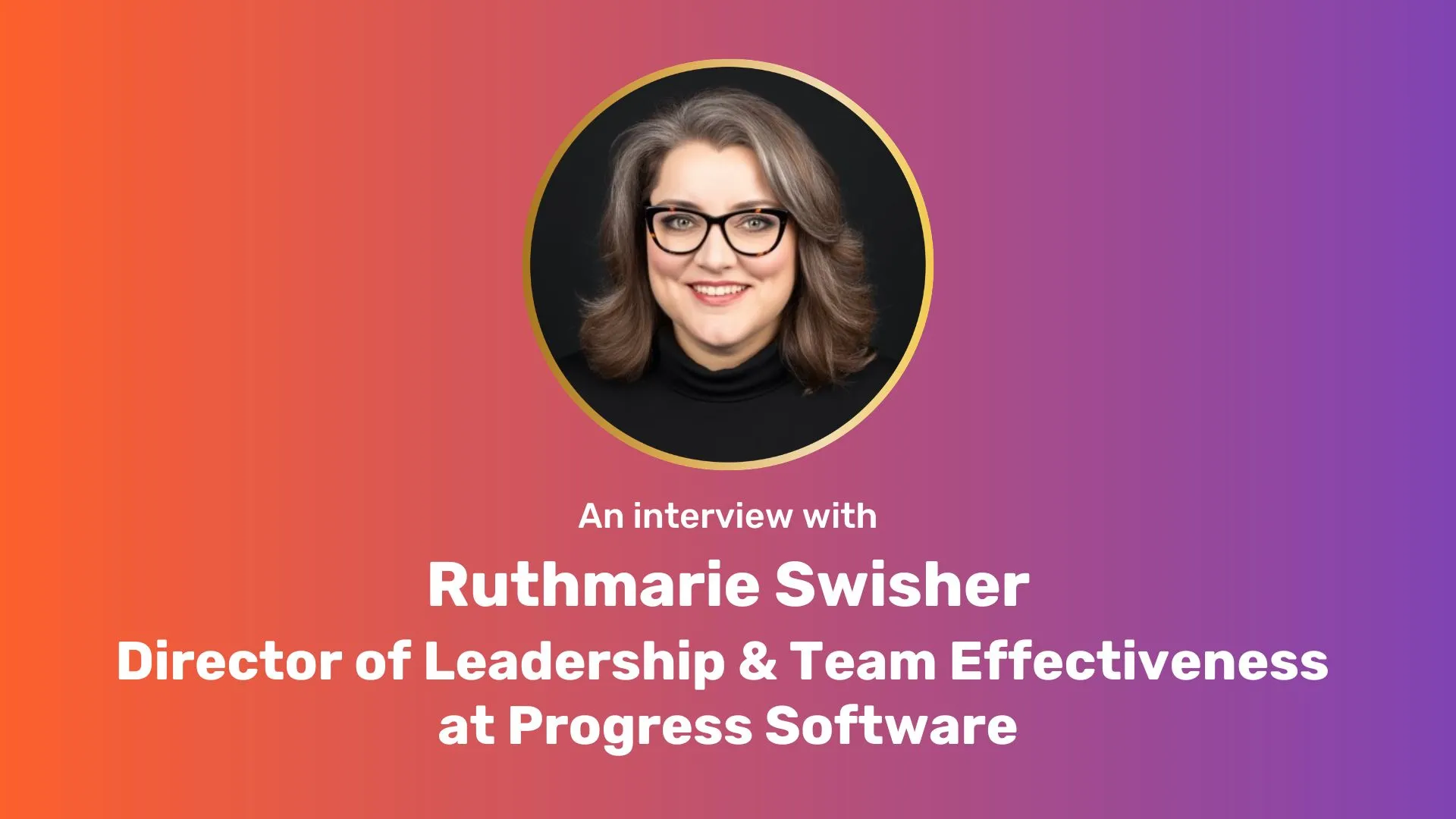
Insights from Ruthmarie Swisher, Director of Leadership & Team Effectiveness at Progress Software
Electives Co-Founder Jason Lavender sat down with Ruthmarie Swisher, Director of Leadership & Team Effectiveness at Progress Software, to learn how the Talent & Culture team is building integrated talent systems, why belonging drives everything and what makes learning stick: from shifting from a content provider to a business partner to running internal AI hackathons.
Key topics covered:
- How L&D teams have evolved from content delivery to business alignment
- Why successful companies treat talent as a system
- Why modern learning is about accelerators, not education events
- “Learning Hours” at Progress and responding to feedback
- How the Talent & Culture team ran their own AI hackathon
- Why belonging and helping people reach full potential drives everything
- What radical adaptability means for the next few years
A fundamental shift: from content provider to business partner
Over the last decade, L&D has undergone a fundamental shift. What used to be about delivering training content has become about developing culture, building leaders, and aligning talent practices to business strategy.
"I have seen learning and development shift from being a provider of content, or a tool or a resource to looking at that full cycle, full spectrum of talent development, organizational strength, all of that. What used to be about delivering training is now about developing culture, developing leaders and aligning our talent practices to what the business strategy is."
The shift goes deeper than just what gets delivered. L&D teams are moving away from building one-off programs—no matter how good those programs are—and toward thinking about the entire employee lifecycle. What does a leader need at different stages? What skills does the business need now versus in two years?
Successful companies treat “talent as a system”
What separates companies that develop talent well from those that don't?
"The companies that excel at development look at talent as a system. And they integrate that system into the business flow.”
This means timing development around the actual rhythms of the business. If there's a sales kickoff coming up, don't schedule mandatory training the week before. Instead, think about what leaders need before that moment to make the kickoff more effective, and what support they'll need afterward to sustain momentum.
Development becomes contextual, not calendar-driven. Companies that struggle with development tend to be fragmented—they have disconnected tools, inconsistent manager capabilities, and programs that don't connect to business priorities.
"Companies that have a hard time are fragmented. They may have too many disconnected tools, maybe their manager capability is inconsistent across the board or maybe they're not connected to the business priorities, and that's where some groups can struggle."
Talent is part of the business planning dialogue
At Progress, talent and development aren't things that get addressed once HR makes a pitch. They're woven into ongoing business conversations.
"I've experienced [talent and development] being part of the business dialogue. It's an ongoing thing. When we need someone to sponsor or join a program to speak, it's always an absolute yes. Jump right in and do it, because the recognition of having those touchpoints with our managers, our leaders and our employees is so important."
Leadership at Progress is genuinely bought in. That recognition, that development, those touchpoints matter - it creates a different culture.
Even when budget constraints come up, the conversation shifts. Instead of cutting programs, leaders at Progress ask what can be done with existing tools and resources. Ruthmarie experienced this firsthand when a significant budget item had to be reconsidered.
"One of them, we've launched this week. Another one, we had to pull back. And the reason why was really fascinating, because the question was asked by leadership, hey, what can you do with AI right now? Instead of going out and getting that service, how can we look in and look at what we have access to with artificial intelligence to support that need?"
That question—what can we do with what we have?—led to experimentation and learning. The process wasn't smooth, but it was educational.
"We did that. Was it smooth? No. There was a lot of learning done through it, and we learned what is needed for this year. It also gave me a crash course in working with artificial intelligence right away, so I appreciated that."
Modern learning is “accelerators,” not just educational events
What does modern learning look like? Ruthmarie offers a reframe: development should be an accelerator, not just an educational event.
"I believe modern learning is looking at development more as an accelerator, not just an educational action or an event. Because if there are investments being made by your company, in the architecture of your knowledge, it goes back to systems. It's going to create systems and pathways, and learning and development becomes something that you just do. It's not separate."
When learning is built as a system, it creates pathways. It becomes part of how work gets done, not something separate from work. This becomes particularly important as companies scale.
"Then that development will come in very handy as you are looking to scale your business, especially in the environment that we're in. That's a lot of what we've been talking about, is how do we prepare our senior leaders? How do we prepare our employees to develop based on the scale of growth or the speed of growth."
“Learning Hours” and responding to feedback
At Progress, they run something called “Learning Hours,” sessions designed around what employees ask for and need. When feedback from courses reveals interest in a specific topic, they bring in organizations like Electives to address it.
"One of the things that I love about being at Progress is the feedback from those courses. We take a look, and that's when we go and engage organizations like Electives to say, hey, we have an interest in this topic, could you come to one of our learning hours?"
This year, her colleagues expanded Learning Hours beyond leadership and soft skills. They added a technical track where people from different parts of the business come in to teach about the technologies and products Progress works on.
"This year, with our learning hours, the great thing about that is where we have looked at certain skills that we know our managers and leaders and employees are interested in, my colleagues introduced a track that talks about the business. It's a technical track. So we have people coming in from different parts of the business to teach us about the technologies and the things that we're doing across Progress."
Progress runs an engagement survey called AllSpark every year and Progress puts that data to work across the organization.
"We have an AllSpark survey, and it happens each year, and I have been so impressed with how that content is everywhere in the organization. We have the survey, and it doesn't just sit on a shelf and, you know, collect that digital dust. It's used by our HR business partners, with their customers to say, okay, what are we going to do about this? What are our goals and objectives based on this feedback this year?"
The talent and culture team uses the feedback to identify topics for Learning Hours. When survey data reveals a need, they can respond quickly.
"We also use it in our talent and culture organization. We look at that feedback, and for example that's some of the places where we get topics for our learning hours that we have. Having a quick response—this was seen as a need, we're now able to quickly accelerate and get it out there and get products or tools and resources out to people, that's a great ability as a team to have."
This feedback loop creates new opportunities. When Learning Hours see high attendance and positive feedback, that data informs what gets expanded, like the technical track.
"With the success and attendance of things like our learning hours, with the feedback we've gotten, that's where we learned we can develop this into a technical track. My colleagues went, and now they're offering two sets, which is great, because I can say, oh, I'm familiar with that topic, but I want to learn more about how the business works, how this product works, and how we operate in this area."
It's a simple idea with powerful results: make learning responsive to what people need and create opportunities to understand the business itself, not just develop generic skills.
Leading by example: the People + L&D team ran their own AI hackathon
When Ruthmarie's leader organized the Talent & Culture team's first off-site, she didn't only do team-building exercises. She ran an AI hackathon for the team itself.
"My leader, she hosted an off-site for us last year. It was our first off-site where we all got together as a group, and one of the things she did was an AI hackathon. She put up real business cases or uses for artificial intelligence within talent development. We each took one, we broke out into teams and we played with it. We were given a certain amount of time, we came up with a 5-minute presentation of what we would do and went off and got more familiar with it."
The approach matters. People fear AI when they don't get hands-on experience with it. By treating AI tools as learning opportunities rather than threats, teams can build fluency.
"I also think it's important to look at those tools as learning opportunities, because people are afraid of it. Our leaders and our teammates, we need to circle around them and say, I understand that this is new. However, learning about it and using it is only going to make us more fluent in it, and that is going to be the differentiator in how artificial intelligence is worked into our workday."
It's about creating a culture where people feel supported in learning new tools together, not just adoption.
Passion: Belonging and helping people reach full potential
Two things drive Ruthmarie's work. The first is belonging—a value that stems from her own childhood experience of being the new kid in three different middle schools.
"It's really two parts. The first part is making sure there is a sense of belonging in the work environment. That really stems from my childhood, because I had the circumstance of being in three different middle schools. While there's a tough time for anybody to be in three different middle schools, I learned to adapt really quickly. One of the things that became important to me is realizing when somebody doesn't feel like they fit in, what can people do? What's helpful? What can people do? Because I certainly appreciated it, being the new kid."
That experience shaped how she thinks about every moment at Progress. Belonging isn't a one-time thing. It's something people need at every transition.
"I think about that every time there's an orientation, every time somebody goes onto a new team, even if they're in the same company. That's something that is a value of mine, is making sure that people know and feel they belong."
The second thing that drives Ruthmarie is helping people discover strengths they didn't know they had. She has experienced leaders and mentors who have pointed out skills she took for granted—moments that changed how she saw her own capabilities.
" The second piece that drives me is making sure people get to realize their full potential. I cannot tell you how many times in my career I have had leaders, whether it be my direct manager or a colleague, say I really appreciate this skill you have, or what you brought to this project. You step back and you think, oh, great, and then you reflect on that, well, they saw that. I took it for granted."
Now she does that for others. She points out what people do well, helps them build on existing strengths, and designs experiences that connect people and build networks—all while making sure those experiences tie to business outcomes.
"I loved doing that, and I still do love doing that, as a talent professional, as a manager, as a leader, to be able to say, hey, you did this really well. You know, let's keep building on that. Or, you know what? This could really help you complement the skills you already have. Let's build on this area. I like designing experiences that connect people and build networks and making sure that they are both tied to our business outcomes. I think that's really important."
Prediction: Radical adaptability is the capability everyone will need
Looking ahead to the next few years, Ruthmarie sees three critical capabilities emerging: leaders who are comfortable adapting, AI fluency across the organization and stronger decision-making skills to match the speed at which business moves.
"People are going to need leaders who are comfortable adapting. I also think that everyone in an organization is going to need some sort of artificial intelligence fluency and to know how to operate within AI. Our leaders will continue to build on their decision-making skills, because of the speed that we're all moving, that's going to be really important."
But speed and adaptability alone aren't enough. Leaders also need space to step back and assess the environment they're creating. Is there psychological safety? Can people learn quickly? What happens in moments of uncertainty?
"While all this change is happening at the rate it's happening, to make sure that our leaders have a chance to look at the environment and assess: do we have an environment that supports people? Is there psychological safety here? Are people able to learn quickly? What happens in moments of uncertainty? To be able to check those barometers, if you will, and check on the culture that they have in front of them."
These cultural checks matter. Without them, speed just creates burnout.
No more fragmented approaches or disconnected tools and learn by doing
Treating talent as a system means no more fragmented approaches or disconnected tools. Development becomes part of the business flow—timed around sales kickoffs, responsive to survey feedback, built into planning conversations from day one.
Leaders run hackathons for their own teams, leading by example. Learning Hours evolve based on what employees actually need. People belong and reach their full potential because the architecture supports it, not because someone remembered to send a training calendar.
At Progress, Ruthmarie and the Talent & Culture team prove it works when you stop treating L&D like an island and start building talent as a system.


.jpeg)