.webp)
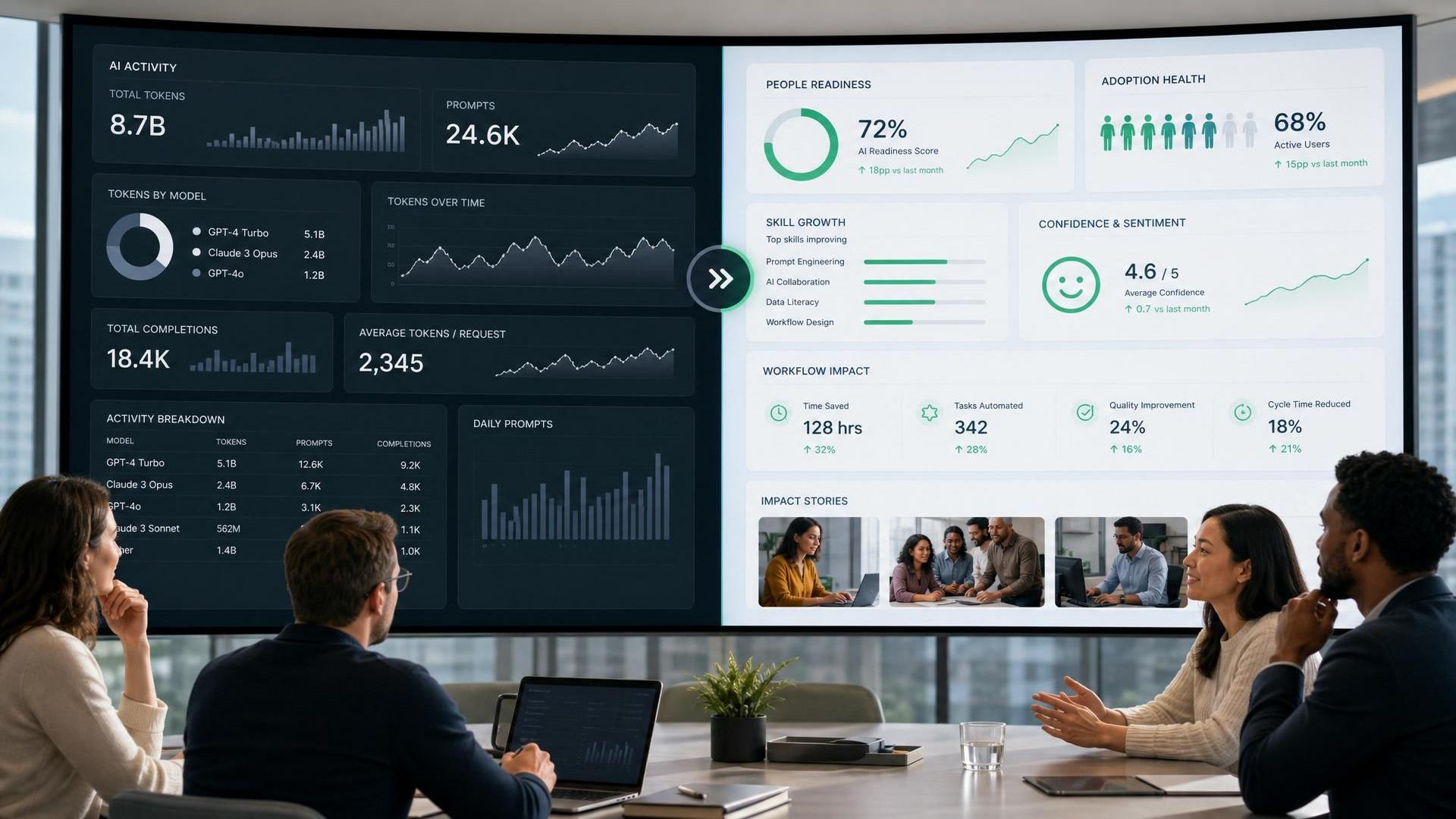
Token maxxing is not an AI readiness assessment, nor is it an AI strategy. It is a receipt for activity. In 2026, the credible benchmark for workforce AI readiness is whether people change workflows, apply AI to real use cases and create measurable impact. Enterprise AI pilots can be everywhere and still produce little measurable return.
Token maxxing is the wrong scoreboard.
Token maxxing is what happens when AI usage becomes the goal.
More tokens. More prompts. More automated runs. More people on the leaderboard.
That can look like momentum. It can also hide the truth.
A team can burn through tokens and still make the same decisions, run the same meetings, write the same handoffs and review the same work twice because no one trusts the output. That is not transformation. That is expensive activity.
Built In defines tokenmaxxing as maximizing AI usage by consuming as many tokens as possible, often treating high utilization as a proxy for productivity regardless of the output. That last phrase is the problem. Output is not impact. Usage is not readiness. Prompt volume is not proof that work changed.
The better question is simple: what is different now? Is the business performing better?
If the answer is “we assigned licenses” or “prompt volume is up,” you do not have an AI adoption strategy yet. You have an activity report.
What should an AI readiness assessment measure?
An AI readiness assessment should measure the human conditions required for AI to change work.
That starts before training. You need to know who is confident, who is blocked, who is experimenting safely, which teams have real use cases and where adoption is uneven. Otherwise, you are guessing.
Most companies will not fail at AI because they picked the wrong tools. They will fail because their workforce never changed how work gets done.
That is why workforce AI readiness is not a software inventory. It is a behavior-change benchmark. A useful benchmark tells you:
- Which employees understand where AI fits their work.
- Which teams have practical use cases worth scaling.
- Where fear, risk, policy confusion or lack of confidence is slowing adoption.
- Whether employees can apply AI skills on the job, not just complete a class.
- Whether workflows are improving in ways the business can see.
The first move is visibility. Our AI Fluency & Culture Assessment baselines AI fluency, sentiment, confidence, blockers and opportunities team by team in under a week. The assessment gives leaders a map before they spend more money on broad training, another tool rollout or another dashboard that only shows activity.
If you want the deeper case for why readiness starts before a company-wide rollout, this is the same argument behind AI readiness starts with people, not platforms.
Board reporting on AI has to move past license counts.
A board does not need to hear that people have access to AI.
They need to know whether the organization is getting better because of it.
That means board reporting AI progress should move from “who has a license?” to “what changed in the business?” It should include workforce baseline data, adoption gaps, confidence, blockers, skill application, behavior change and evidence that employees are applying new AI skills on the job.
McKinsey’s latest state of AI research makes the same shift clear. The report found that only 21% of respondents whose organizations use gen AI say their organizations have fundamentally redesigned at least some workflows. It also found that, among 12 adoption and scaling practices, tracking well-defined KPIs had the strongest relationship with bottom-line impact, while less than one in five respondents said their organizations were tracking KPIs for gen AI solutions at all.
That is the gap.
AI activity is easy to count. AI impact takes discipline to prove.
The 2026 AI readiness benchmark checklist.
A credible organizational AI benchmarking model should separate input metrics from impact metrics.
Input metrics still matter. You should know license activation, attendance and utilization. But those are not the benchmark. They are supporting signals.
The benchmark should answer eight questions:
- Do we know our starting point? Baseline AI fluency, confidence, sentiment, blockers and team-by-team readiness before you launch more training.
- Are employees applying AI to real use cases? Track use cases tied to actual workflows, not generic prompt practice.
- Are workflows changing? Look for redesigned steps, reduced manual rework, clearer handoffs and better use of employee time.
- Is decision quality improving? AI that helps someone make a bad decision faster is not progress.
- Are employees confident and safe? Measure whether people know when to use AI, when not to use it and how to manage risk.
- Where are adoption gaps? Compare teams, roles and functions so support goes where it is needed.
- Are managers reinforcing the behavior? Managers turn AI from a personal experiment into a team operating habit.
- Can we prove business impact? Tie AI adoption to cycle time, quality, customer outcomes, cost reduction or capacity created.
This is what separates AI readiness assessment from AI theater.
Deloitte’s 2026 State of AI in the Enterprise research points in the same direction: roles, skills and career paths should be rebuilt, not simply adjusted, as organizations redesign work around AI. The report is based on a survey of 3,235 leaders across 24 countries conducted in 2025.
The benchmark is not “did people use AI?”
The benchmark is “did AI change how valuable work gets done?”
High usage can still hide uneven readiness.
A company-wide usage chart can make adoption look broad when it is actually narrow.
One team may be using AI for customer research synthesis. Another may be asking it to rewrite emails. Another may be avoiding it because policy feels unclear. The aggregate number says “usage is up.” The team-by-team reality says “readiness is uneven.”
Anthropic’s Economic Index shows why this matters. In one analysis of Claude.ai usage, Anthropic found that even across 3,000 unique work tasks, the top 10 accounted for 24% of activity, and that AI’s impact remains uneven across countries, occupations and task coverage rather than uniform.
That is exactly why HR and L&D leaders need more than platform analytics.
You need to see where AI is becoming part of the workflow and where it is still a side tab. You need to know whether employees are practicing with realistic scenarios, getting feedback and building judgment before they use AI on high-stakes work.
Most AI training teaches tools. We change how your organization works.
At Electives, that means live, expert-led classes, realistic AI simulations and analytics that prove behavior change. In our programs, 92% of learners report behavior change and 98% apply new AI skills within one week of training. Those are the signals that matter. Not because they sound better in a slide, but because they show the work is moving from awareness to application.
For a practical evaluation lens, our AI training for employees 2026 framework walks through how to compare programs on rollout, practice, governance and measurable behavior change.
What should you report to the board instead?
Your AI dashboard should tell a story of movement.
Not a story of access. Not a story of completion. Movement.
A stronger board narrative looks like this:
- Starting point: “We assessed AI fluency, confidence, sentiment and blockers across teams.”
- Adoption gaps: “We found three teams with high confidence but low use-case clarity, and two teams with strong use cases but risk concerns.”
- Action taken: “We targeted live learning and practice by team need.”
- Behavior change: “Learners are applying AI skills within the week and managers are reinforcing new workflows.”
- Business signal: “We are tracking cycle time, quality, capacity created and customer-facing improvements tied to priority use cases.”
That is a real AI adoption strategy.
It gives the board something license counts cannot: a view of whether the workforce is becoming AI-first in practice.
Start with the map.
The best AI strategy is a People strategy.
If your AI report is still built around tokens, prompts, licenses and completions, you are measuring the easiest part of the change. Not the most important part.
Start with an AI readiness assessment. Get the baseline. See the blockers. Find the teams already moving. Then build the learning, practice and measurement system that turns AI from individual experimentation into a new way of working.
Stop guessing. If you want to see where your workforce is ready, blocked or already changing how work gets done, let’s start with the AI Fluency & Culture Assessment.


.jpeg)
.jpeg)